Resume & CV
Examples of Soft Skills on a Resume: 13 You Can Prove
Use examples of soft skills on your resume only when they match the job description and you can prove them. The most relevant soft skills belong in your experience, projects, professional summary, or skills section, as long as your experience proves them.
You may already know which soft skills describe you. The harder question is whether someone reading your resume can see them in the work you have shown.
Written By Ita John
Founder, CVJury
Published 31 March 2024Updated 12 October 202615 min readPrimarily for a US resume audience

Start With the Skills You Can Prove
Soft skills earn space on your resume when three things are true:
- Does the job need it? The job description names the skill or the work plainly depends on it.
- Have you used it? You can point to work, group projects, education, volunteering, or another real responsibility.
- Can you prove it? A task, decision, or outcome shows soft skills in action.
NACE's 2026 early-career employer research highlights communication, teamwork, and problem-solving on new-graduate resumes. NACE also tells candidates to show examples rather than rely on a list of skill names. The World Economic Forum's 2025 employer research also rates analytical thinking; resilience, flexibility, and agility; leadership and social influence; and creative thinking highly. The sources study different groups, so no universal ranking follows.
The job decides which soft skills matter. Your evidence decides which ones deserve space on the page.
Why Soft Skills Matter on a Resume
Soft skills describe how you communicate, work with people, think through problems, organize work, make decisions, and respond to change. Many soft skills transfer between roles and industries.
Hard skills still matter. When the job calls for them, technical abilities need their own proof. Show hard and soft skills side by side instead of treating one as more important than the other.
Soft skills matter because employers need to see how you carry out the work, not just whether you know the tool or subject. Communication keeps information clear between people, and teamwork helps people work toward shared goals. Problem solving helps you deal with obstacles, emotional intelligence helps you build positive relationships, and time management helps you prioritize tasks and meet deadlines.
No single soft skill guarantees professional success, and no list of top soft skills fits every role. The ones worth naming depend on the job in front of you.
Hard and Soft Skills: Where Computer Skills Fit
Unlike hard skills, soft skills are usually learned behaviors and human abilities that transfer across more than one type of work. Hard skills are more closely tied to technical expertise or a task, tool, process, or field.
US BLS skills data treats computer and IT abilities separately from interpersonal and problem-solving groups, so computer and software abilities belong with technical skills. Excel, coding, bookkeeping software, data tools, and operating specialist systems are technical abilities. Calling them soft skills blurs the distinction.
Technical competence still needs its own proof; communication or teamwork does not substitute for it.
Certain soft skills sit alongside technical work. A project manager may need technical knowledge alongside communication, planning, negotiation skills, and decision-making skills. Name the part you are proving.
How to Choose Specific Soft Skills for Your Resume
Do not copy a list of important soft skills and work backward. Start with the vacancy.
Read the job description and mark words that describe how the work gets done: "work across teams," "manage competing deadlines," "resolve customer issues," "present findings," "coach colleagues," or "adapt to changing priorities."
Match those needs with evidence from your own history, then run each possible skill through the same three questions.
| Ask | Keep the Skill When... | Leave It Out When... |
|---|---|---|
| Does the job need it? | The vacancy names it, or the duties depend on it | It has little connection to the role |
| Have you used it? | You point to a task, project, decision, or responsibility | You only like the label |
| Can you prove it? | A resume line shows what you did with the skill | The claim would sit alone in a soft skills section |
Your strongest soft skills are the ones that fit the role and have convincing proof behind them.
That simple check prevents the Keyword Dump: a dedicated skills section packed with labels that never show up in your evidence.
13 Examples of Soft Skills to Use on a Resume
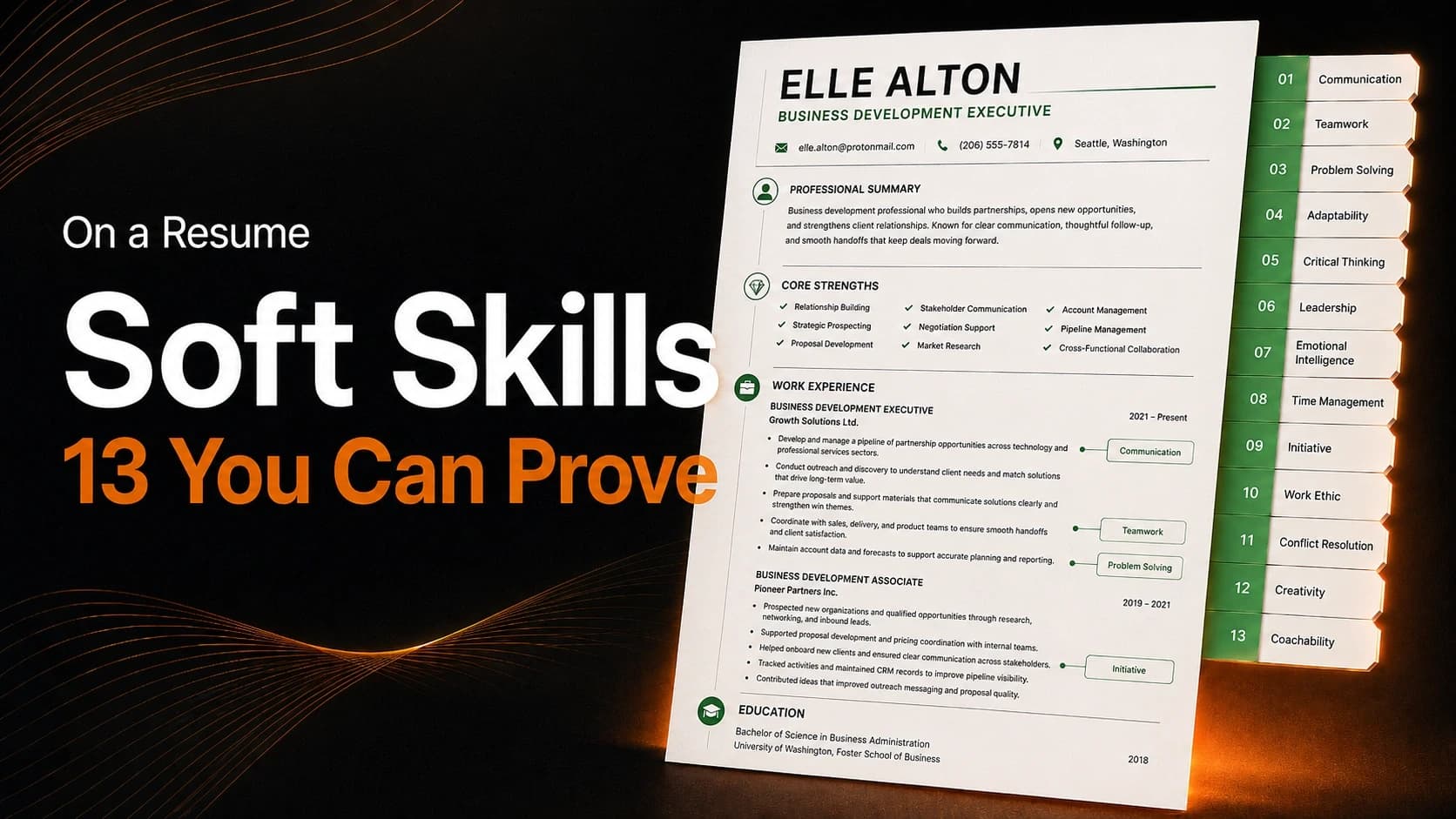
These 13 soft-skill groups are options, not a target number for your skills section.
| Soft Skill | Proof to Look For |
|---|---|
| Communication and active listening | Verbal communication, written communication, listening, explaining, clarifying, feedback |
| Teamwork and collaboration | Shared goals, handoffs, a cross-functional team, support for colleagues, and related team dynamics |
| Problem solving | Finding causes, comparing options, fixing recurring issues |
| Adaptability and flexibility | Learning new processes, responding to change, adjusting plans |
| Critical thinking and analytical thinking | Checking evidence, comparing information, questioning assumptions |
| Leadership and decision-making | Coordinating people, mentoring, setting direction, making decisions |
| Emotional intelligence, interpersonal skills, and social skills | Empathy, self-awareness, relationship handling, reading other people |
| Time management and organization | Planning, deadlines, prioritizing, accurate tracking, attention to detail |
| Initiative and self-motivation | Spotting useful work, starting it, following through |
| Work ethic and reliability | Accountability, integrity, dependability, consistency |
| Conflict resolution and negotiation | De-escalation, shared interests, compromise, agreement |
| Creativity and innovative thinking | New approaches, useful ideas, new ways to explain or deliver work |
| Coachability and active learning | Seeking feedback, applying it, learning unfamiliar work |
Communication and Active Listening
Communication covers verbal communication, written communication, listening, questioning, and feedback. Your communication style changes with the audience: a customer needs plain language; a manager needs the short version; a technical colleague needs exact detail.
Active listening is more than body language. It means paying attention, checking what you understood, and responding to the real issue. Body language is only one part of nonverbal communication.
O*NET describes active listening as giving full attention, understanding what is being said, asking appropriate questions, and avoiding unnecessary interruption.
Example resume line: Resolved customer queries by listening for the issue, confirming the request, and explaining the action in plain language.
Why it works: You can see active listening and communicating effectively in the action rather than in a claim of "excellent communication." If customer satisfaction is measured in your role, use the figure. Do not invent one.
Teamwork and Collaboration
You show teamwork skills when you support peers and help a group reach a shared goal. Team collaboration is visible in handoffs, shared decisions, problem-solving, and work that depends on more than one person.
Example resume line: Coordinated weekly handoffs with a cross-functional team so open customer requests reached the right owner before the agreed deadline.
Why it works: When several people own the result, name the part you handled in the handoff or decision. Do not claim the whole team's result as your own.
Problem-Solving
Problem-solving means identifying what is wrong, checking likely causes, comparing options, and choosing a workable response. People solve problems across service, operations, finance, administration, technology, and education.
Example resume line: Traced repeated invoice errors to an inconsistent handoff, documented the failure point, and proposed a check before billing.
Why it works: The outcome does not have to be a complete win. A clear diagnosis can show how you solve problems even when the final result is outside your control.
Adaptability and Flexibility
You prove adaptability when priorities, tools, processes, or working conditions change and you adjust without losing control of the work. Flexibility becomes convincing when your resume shows the adjustment you made.
Resilience fits here when your evidence shows how you recovered from a setback, adjusted your approach, and kept the work moving.
Example resume line: Learned a new scheduling process during a system change and rewrote the team handover notes so the new steps were recorded in one place.
Why it works: Keep the changed condition in the bullet so the reader can see what you adapted to. Without that context, the adjustment is easy to miss.
Critical Thinking and Analytical Thinking
Critical thinking asks whether information is trustworthy and whether an assumption holds up. Analytical thinking breaks a problem into parts, compares the options, and helps you reach a reasoned decision.
Critical thinkers do not need academic language on a resume. Name what you examined and the decision that followed.
Example resume line: Compared supplier quotes, delivery limits, and contract terms before recommending the option that met the project requirements.
Why it works: Name the information you compared and the decision it informed. Leave out reasoning steps that do not help the reader judge the choice.
Leadership and Decision-Making
Not every role requires strong leadership skills. Use leadership when the vacancy calls for it and your history supports it. You do not need a manager title to prove leadership. Mentoring, coordination, ownership, training, and decision-making can all show it.
Example resume line: Coordinated a group project, assigned work based on availability, checked progress, and resolved missed handoffs before submission.
Why it works: This shows decision-making skills and responsibility without giving the person a management title they did not hold.
Emotional Intelligence, Interpersonal Skills, and Social Skills
Emotional intelligence covers self-awareness, empathy, emotional control, and awareness of other people. How your abilities shape work with colleagues, clients, customers, or partners falls under interpersonal skills. Social skills sit inside this group when they describe how you interact effectively with others.
When the role involves people from different backgrounds, show how you adjusted your communication and worked respectfully across differences.
Writing "high emotional intelligence" does not prove strong emotional intelligence. Show the behavior.
Example resume line: De-escalated a frustrated customer conversation by listening without interruption, restating the issue, and agreeing on the action needed to resolve it.
Why it works: Use behavior a hiring manager can check, such as listening, restating, or de-escalating. Labels such as "empathetic" are still self-assessments.
Time Management and Organization
Think of time management as deciding what to do first, planning around deadlines, and keeping work from slipping. Organization covers how you track tasks, records, handoffs, and details. Those ideas overlap enough to sit together.
Example resume line: Prioritized service requests by deadline and business impact, updated the tracker, and flagged blocked work before it became overdue.
Why it works: If one bullet starts carrying several deadlines and tasks, keep the priority, tracking action, and result. Too much detail hides the judgment behind the work.
Initiative and Self-Motivation
Initiative starts with noticing useful work and acting without waiting for the boss to direct every step. Self-motivation shows in the follow-through.
Example resume line: Noticed new starters were asking the same process questions, drafted a reference guide, and shared it with the team.
Why it works: Initiative can come from routine or unpaid work too. What matters is that you noticed a need and acted without being assigned every step.
Work Ethic and Reliability
Work ethic is too broad to stand on its own. Show dependability, accountability, integrity, attention to detail, accurate records, punctual follow-through, or simply doing what you said you would do. Discipline and consistency belong here too.
Example resume line: Maintained accurate shift records, completed handovers before leaving, and flagged missing information for the incoming team.
Why it works: For repetitive work, consistency, accurate records, and reliable handoffs can be stronger proof than a one-off project. Show the habit another person depended on.
Conflict Resolution and Negotiation
Conflict resolution draws on communication, listening, empathy, judgment, and de-escalation. Negotiation skills add preparation, competing interests, trade-offs, and agreement.
Example resume line: Resolved competing scheduling requests by confirming each team's fixed dates and agreeing on a workable sequence for the remaining work.
Why it works: One bullet can prove conflict resolution, communication, and negotiation at the same time. Let the action carry the overlap instead of forcing every skill name into the sentence.
Creativity and Innovative Thinking
Creativity appears when you find a new way to explain, organize, solve, present, or deliver something. How much creativity matters depends on the role.
Example resume line: Reworked a confusing customer email into a shorter step-by-step message that answered recurring questions in one place.
Why it works: The change in approach is clear without treating creativity as a universal requirement.
Coachability and Active Learning
Coachability means receiving feedback, working out what needs to change, and applying the lesson. Active learning is about picking up unfamiliar work as the role changes.
An online course gives you structured practice in a soft skill or technical expertise, but completion alone does not prove workplace performance. Show what you did with what you learned.
Example resume line: Applied supervisor feedback to revise weekly reports, using a fixed heading order and shorter commentary on each issue.
Why it works: The feedback is visibly put to use, which is stronger evidence of continuous learning than a course title alone.
How to Showcase Soft Skills on Your Resume
A skills section names relevant soft skills. Your experience does more of the proving because hiring managers can assess an action more easily than an adjective.
Experience Bullet Points Show the Proof
Compare these two lines:
Weak:
Excellent communication, teamwork, and leadership skills.
Stronger:
Coordinated weekly handoffs across customer service and operations, clarified open issues, and assigned each follow-up to an owner.
The stronger bullet shows the action and proves communication and teamwork without naming either one.
Choose action verbs that accurately reflect the work: coordinated, explained, resolved, analyzed, coached, negotiated, prioritized, or trained.
See How One Real Resume Proves Soft Skills
This redacted CVJury client sample shows the same proof principle on a real rewritten resume: soft skills become visible when the bullet points describe work, choices, and collaboration.
The right-hand notes identify eight soft skills already demonstrated in the resume, so you can scan the proof quickly.
ILLUSTRATIVE EXAMPLE

Published with the client’s written permission. Identifying details have been redacted. The quoted excerpts and annotations are included for teaching purposes.
Real resume line: "Worked with sales, product and marketing colleagues to bring a new product to market, keeping priorities, messaging and launch activity aligned."
What it proves: The line gives the reader a checkable communication and teamwork action. It shows who the candidate worked with and what had to stay aligned, without adding "great communicator" or "team player."
Real resume line: "Built productive partner relationships by listening to different priorities, finding shared interests and keeping joint marketing activity moving."
What it proves: This line shows active listening, emotional intelligence, interpersonal skills, and relationship building through behaviors. The shared-interests detail shows how the candidate handled different priorities, not just that relationships existed.
Notice the pattern: this resume does not rely on a generic list of personal traits. The skills appear through concrete tasks such as coordinating launches, reviewing campaign data, adjusting priorities, and helping colleagues move work forward.
A resume achievement does not need a number every time. If you need help finding credible evidence in your own work, use our resume accomplishments guide.
Use the Professional Summary Selectively
Use your professional summary to highlight soft skills only when they define your work and the rest of the resume proves them.
Weak:
Hardworking professional with excellent communication and teamwork skills.
Stronger:
Operations professional who coordinates service requests, resolves customer issues, and keeps cross-team work on schedule.
The second professional summary gives hiring managers evidence they can check against the experience section.
Use the Skills Section to Name, Not Prove
A skills section can highlight soft skills in the same role-matched language the vacancy uses, rather than turning into a paragraph of personal attributes.
Name it here. Prove it elsewhere. Think of the skills section as an index. Your experience is where the proof lives. If the vacancy asks for conflict resolution, communication, and time management, and your experience supports those terms, include them in the skills section. Show the proof elsewhere.
Projects, Education, and Volunteering Count Too
Many job seekers with limited paid experience draw proof from group projects, volunteering, internships, community work, or other responsibilities.
Weak:
Team player with leadership skills.
Stronger:
Coordinated a student project schedule, assigned research tasks, followed up on missed deadlines, and presented the group’s findings.
That line proves teamwork, time management, written communication, verbal communication, and leadership-related behaviors.
Applicant Tracking Systems and Soft-Skill Keywords
Use job-description wording when it truthfully describes your experience. Put key skills where they belong naturally, then prove the main ones with evidence.
Applicant tracking systems are one part of the hiring process, not a reason to repeat the same soft skill across every section. There is no universal ATS rule that says a set number of soft-skill keywords improves ranking.
Keep your resume and cover letter consistent about the abilities you claim. A cover letter adds a short story or reason for fit, but the resume should carry its own proof. Do not turn the cover letter into a duplicate skills list.
The same evidence helps in job interviews, too. During the interview process, you can point to where you used an ability and discuss a concrete example.
Build Soft Skills Through Practice and Feedback
OECD research says many social and emotional abilities develop through learning and experience.
Build soft skills through real responsibilities, feedback, volunteering, group projects, practice, and personal development. The useful question is not "Did I attend training?" It is "Where did I use the skill afterward?"
An online course can teach a method or give you practice. Your resume still needs evidence of what you did afterward.
For your job search, choose the soft skills the role needs, build any you lack, use them in real work or practice, then put the evidence on your resume. Unsupported claims do not strengthen your job search.
Common Soft-Skill Resume Mistakes
Today's job market does not make a longer list of traits more convincing. What makes soft skills important is whether they matter to the work and whether you can prove them.
The Keyword Dump
A long soft skills section packed with communication, empathy, creativity, leadership, adaptability, positive attitude, and teamwork creates work for the reader. Keep only the specific soft skills that fit the role, then prove them where you describe the work.
The Empty Skill Label
"Great communicator," "natural leader," and "team player" are opinions about yourself. Replace the label with a task or result that lets the hiring manager judge the skill.
The Rating Bar
Rating skills on your resume with stars or progress bars turns your opinion into a score without giving the employer any evidence. Use that space to show what you actually did instead.
The Technical-Skill Mix-up
Do not label software, coding, data tools, or computer operation as soft skills. Keep technical skills and technical expertise in the part of the resume that fits them.
The Fake Metric
Do not invent percentages, savings, customer satisfaction figures, or team sizes to make an example look impressive. Without a trustworthy number, use non-numeric proof.
The Off-Target Skill
A skill may be real and still waste space on a particular application. If a role asks for analysis, independent case work, and attention to detail, a long claim about public speaking adds little. Choose the abilities tied to the work.
Frequently Asked Questions
Can one resume bullet prove more than one soft skill?
Yes. A line about resolving a customer issue, coordinating with another team, and meeting a deadline can show communication, teamwork, problem solving, and time management. Keep the bullet focused on the work, not the labels.
How should career changers show soft skills?
Use transferable skills that connect your previous work to the new role. Prove communication, problem solving, leadership, or time management from earlier experience, and keep hard skills separate.
Are personality traits the same as soft skills on a resume?
Not exactly. A label such as friendly or positive attitude describes you; resume evidence shows behavior such as active listening, conflict resolution, reliability, or team collaboration.
Which soft skill should I choose when two fit the role?
Choose the one with clearer proof and a closer link to the vacancy. If one bullet genuinely shows both, let the action carry both and keep the skills section shorter.
How do I show soft skills when my work is confidential?
Describe the action without naming clients, systems, figures, or restricted details. You can still show negotiation, decision-making, communication, or problem solving by stating your responsibility and the part of the outcome you are allowed to share.
Can I use the same soft skills on every resume?
No. Keep a soft skill only when it fits the role, and your experience supports it. A skill that matters for one vacancy may be less relevant for another, even when both jobs have similar titles.
Key Takeaways
- Does the job need it? Start with the vacancy, not a generic skills list.
- Have you used it? Keep only skills your real experience can support.
- Can you prove it? Show what you did instead of relying on a label.
- Use the skills section to name important terms; let your experience do most of the proving.
- Keep technical skills distinct from soft skills when the distinction matters.
- One resume bullet can prove more than one soft skill when the same action genuinely shows them.
- Use numbers only when they are real and add useful evidence.
Check Your Resume Before You Apply
1
Does each soft skill you name match the vacancy?
2
Can you point to a bullet, project, or summary line that proves each important one?
3
Does your skills section name only terms your experience can support?
4
Are technical skills kept separate from soft skills?
5
Is every number, result, and claim genuine?
Get a Second Opinion Before You Apply
Need a second opinion? Get a CVJury Expert Resume Review. It provides human edits for a resume draft you already have, with tracked changes, a clean final file, one job-ad alignment check, and a short action report.
Know what you're getting: It is not a full resume rewrite from scratch.
Sources Checked
NACE, “The High-Impact Skills College Students Should Showcase on Their Resumes”
US early-career employer demand and resume evidence.
April 23, 2026 View source
World Economic Forum, “Future of Jobs Report 2025, Skills Outlook”
Global employer-rated skill families. View source
US Bureau of Labor Statistics, “Skills Data”
Occupational skill differences and computer/IT classification. View source
O*NET, “Soft Skills”
Active listening, active learning, critical thinking, and problem-solving definitions. View source
OECD, “Skills That Matter for Success and Well-Being in Adulthood”
Development of social and emotional abilities.
2025 View source
About the author
Ita John
Founder, CVJuryDr Ita John founded CVJury in 2022. He previously worked as an IT recruiter in the London market for nearly seven years at Star Jobs Recruitment and founded the NECareersConnect careers platform. He brings experience in recruitment, practical project management, and business development. Earlier in his career, he taught business and economics at Oxford Brookes University and in Nigeria for over a decade. He lives in England with his wife and three sons. He earned a PhD in Entrepreneurship, International Business, and Economics from Oxford Brookes University. See how his background shapes the work he does for you. Read his story.
Connect
 LinkedIn
 Happenstance
