Resume & CV
How to Write A Good CV (Inspiration Is Really the Proven Key)
Are you ready to unlock the secrets of crafting a good CV that captures the attention of employers and opens doors to exciting job opportunities? We drew inspiration from 86 CV examples we analysed.
Written By Ita John
Founder, CVJury
Published 30 March 2024Updated 12 October 202619 min read


Are you ready to unlock the secrets of crafting a good CV? A CV that captures the attention of employers and opens doors to exciting job opportunities? This comprehensive guide delves into the art of good CV writing.
Have you ever wondered what makes a CV exceptional? How can you showcase your skills and experiences in a way that captivates recruiters? Throughout this article, we answer these questions and provide valuable insights into the essential components that make a CV shine. We drew inspiration from 86 CV examples we analysed. We decoded the elements contributing to making poor CVs and outstanding ones. You'll uncover fresh perspectives and innovative ideas to enhance your CV. Let's guide you through how to tailor your CV to fit the job requirements and how to optimise job titles and showcase your skills.
A good CV will get you more job interviews with employers. It beats the ATS tools recruiters use to sift CVs. So, always scan your resume before you send it off. To ensure your CV meets the mark, use our ATS resume scanner to test the quality of your CV.
Meanwhile, here are the critical elements of an interview-winning CV:
- It's easy to read
- No gaps in the education section or work experience segment
- Uses one of the recommended fonts
- Highlights significant accomplishments
- Factually correct
- It shows; it doesn't tell.
Turn Your CV into a Magnet for Job Offers
You're searching for your dream job, and a well-crafted CV is the key to unlocking countless opportunities. But where do you start? How can you make potential employers notice you?
Did you know that recruiters tend to spend an average of just 7 seconds skimming through a CV? In those fleeting moments, your CV needs to make an unforgettable impression.
cvjury.com
RECRUITER STATS
Get ready to embark on a transformative journey as we guide you through the secrets of crafting an impressive CV that captivates interviewers from the get-go.
In this guide, you'll discover:
- The critical sections to include in your CV to instantly grab attention.
- Strategies to concisely yet impactfully showcase your skills, experiences, and potential.
- Tips for tailoring your CV to specific job requirements and industry expectations.
- Expert advice on what not to do: a case study.
- Techniques to highlight your unique qualities and make a lasting impression.
- Resources to continually refine and optimise your CV for maximum impact.
Are you ready to seize the opportunity to impress interviewers within those precious 7 seconds? Join us on this exciting journey and unlock the power of a remarkable CV that opens doors to your dream job, title, and career.
a. Important Sections for an Attention-Grabbing CV
When crafting a CV instantly grabs attention, it's crucial to include the elements that make a lasting impression on potential employers.
This section will explore the essential components that can transform a good CV into a great one. A CV is a powerful tool that can captivate recruiters from the moment they look at it.
cvjury.com
CV SECTIONS
Image credit: Zippia
1
Compelling Personal Statement
Begin your CV with a concise and impactful personal statement that highlights your key skills, career goals, and what makes you a unique candidate. Showcase your passion and motivation for the role you're applying for. Add your personal details and contact details.
2
Relevant Work Experience
Include your work history in reverse chronological order, starting with the most recent. Focus on positions directly relevant to the job you're applying for, emphasising your accomplishments, responsibilities, and skills gained. Use bulleted points to highlight key achievements, demonstrating your value and impact in previous roles.
3
Education and Qualifications
Include your degrees, certifications, and relevant qualifications in the education section. Highlight any academic achievements, honors, or special projects demonstrating your dedication and expertise in a particular field.
4
Key Skills
Create a dedicated section to showcase your key skills relevant to the job. Include hard skills (technical abilities) and soft skills (communication, teamwork, problem-solving). This demonstrates your well-rounded capabilities. Use concise bullet points to make your skills easily scannable and highlight your strengths.
5
Accomplishments and Awards
Dedicate a section to showcase notable accomplishments, awards, or recognition you have received. Highlight specific achievements demonstrating your capabilities and making you stand out from other candidates.
6
Professional Development and Training
Demonstrate your commitment to continuous learning and growth by including professional development courses, workshops, or certifications. Emphasize any training and professional qualifications directly related to the job or showcase your desire to expand your skill set.
7
References
Include references or indicate that they are available upon request. Choose references to provide positive and relevant insights into your skills and character.
cvjury.com
CVJURY TOOL
b. 10 Strategies: Show off Your Skills and Experience
You know the old saying, if you've got it, flaunt it.
The same goes for your skills. When you write a CV, it's essential to make your relevant skills shine.
You have to sell yourself successfully even before you sit down for the interview. You have to sell yourself simply to get an interview.
Using these strategies will ensure that even the CV of a fresh graduate cuts.
1
Decode Job Description
Study the job advertisement for the job you want. Understand what employers are looking for. Customise your CV to match this, matching their requirements and highlighting relevant achievements and qualifications. This shows that you understand the role, boosting your chances of getting noticed.
2
Action-Packed Language
Use strong action words to describe your skills and experiences. Start bullet points with verbs like "achieved," "implemented," or "led." This shows you have a proactive approach and gives your CV energy and impact.
3
Numbers Speak Louder
Include numbers, percentages, or specific results to show your achievements. Quantifying your accomplishments adds credibility and makes your CV more compelling.
4
Transferable Skills
Highlight hard and soft skills that are useful in various industries or roles. For example, emphasise your project management abilities or your sales skills, and show how they can benefit potential employers.
5
Clear and Concise
Present information in short, easy-to-read sentences. Avoid long paragraphs that can be overwhelming. Bullet points help recruiters quickly understand your professional qualifications and experiences.
6
Relevant Experiences First
Focus on experiences that directly relate to the job you're applying for. To grab attention, start with the most relevant roles and accomplishments.
7
Showcase Your Initiatives
Highlight projects, initiatives, or contributions that show your problem-solving abilities and drive. These examples show your potential and set you apart from other candidates.
8
Let Others Speak for You
Include testimonials or recommendations from previous employers, colleagues, or clients. These endorsements confirm your skills and work ethic, adding credibility. Choose impactful quotes that showcase your strengths.
9
Visual Appeal
Consider adding graphs, charts, or infographics to present data or highlight key achievements. Visual elements make your CV more engaging and memorable.
10
Tailor for Success
Customise your CV for each application to match the specific requirements and company culture. Tailoring shows genuine interest and dedication, increasing your chances of standing out.
cvjury.com
INFOGRAPHIC
c. Tailoring Your CV to Match Your Job Title
To stand out among the crowd, you need to tailor your CV. One size does not fit all. You need to match specific job requirements and industry expectations, showcasing your qualifications, skills, experiences, and personal qualities.
Making sure that they directly align with the desired position. Here are some valuable tips to help you tailor your CV and increase your chances of success:
1
Understand the Job Requirements
Carefully read and analyse the job description. Identify the key skills, qualifications, and experience the employer seeks. Pay attention to specific keywords and phrases in the job posting that highlight the essential criteria.
2
Highlight Relevant Skills and Experiences
Identify the skills and experiences from your work history that closely match the job requirements. Emphasize these relevant skills by placing them prominently in your CV, showing how you have applied them in past jobs. Provide specific examples and results to demonstrate your capabilities.
3
Customise Your CV's Structure and Content
Tailor your CV's structure to highlight the most relevant sections and information. Place the most important information at the beginning of each section. Use concise bullet points, and keep your CV concise and focused.
4
Use Industry-Specific Terminology
Incorporate industry-specific keywords and terminology relevant to the job you are applying for. This demonstrates your familiarity with the industry and makes it easier for recruiters to identify your qualifications.
5
Showcase Your Accomplishments
Highlight your additional qualifications and achievements directly related to the job requirements. Use quantifiable metrics or numbers whenever possible to demonstrate the impact you made during your employment history.
6
Tailor Your CV for Each Application
Customise your CV for each job advert to align with the company's values, culture, and requirements. Research the company and its industry to understand its unique expectations.
7
Proofread and Edit
Thoroughly review your CV to ensure it is free from grammatical errors, typos, or inconsistencies. Ensure you choose the correct writing style. Seek feedback from trusted individuals to gain valuable insights.
cvjury.com
RESUME SCANNER
Tailoring your CV shows your dedication and attention to detail, making you a strong candidate. Take your CV from a standard to a great one, perhaps perfect. Use real-world examples of achievements to prove you are the right fit for this job.
d. What Not to Do: A Case Study
Our case study report shows the common mistakes people make in their CVs. Between April and May 2023, the CVJury Expert CV Review team reviewed 86 CVs as random samples.
Since then, we have reviewed and rewritten over 300 CVs. The nature of the errors we found was chilling. Even top candidates with first-class degrees missed them, too! And 17 candidates among this number had first-class degrees.
We show the details in the following sections. In the following subsections, we tabulate the key areas in which candidates make mistakes in their CVs. We give short notes summarising the nature of those mistakes and advise what to do instead.
Do you make these mistakes in your CV?
Common CV Mistakes We Found (After Reviewing 86 Samples Randomly in May 2023)
- Absence of name and contact details
- Achievements aren't adequately woven into the bullet points
- Body texts are bolded, which is unconventional.
- Clichés
- Content is ambiguous, unclear whether it is intended for an academic or industry role
- Excessive bullet points in CV sections (8 and 7 points instead of 4-5)
- Inconsistencies in formatting, including insufficient spacing before and after headings
- Grammar errors
- Improper use of uppercase letters
- Inclusion of unnecessary information like nationality and date/place of birth
- Inconsistency in tenses
- Inconsistent spelling
- Incorrect heading names (e.g., 'ACADEMICS' instead of 'EDUCATION').
- Ineffective bullet points
- Insufficient evidence of soft and technical skills
- Lack of action verbs
- Lengthy and irrelevant info
- Limited quantitative info
- Listing all jobs and responsibilities, including those that are not directly relevant or from more than 12 years ago
- Missing keywords
- Mixed tenses
- No 'Profile Summary'
- No use of achievement language in the bulleted points
- Organisation issues
- Poor use of bold, font style, and sizes, leading to inconsistency in formatting
- Poorly constructed profile summary
- Redundant headings
- Candidates added secondary and primary education despite having a solid degree
- The CV format is unattractive for a senior role
- The CV lacks critical keywords relating to the job description
- The Profile Summary doesn't offer sufficient value to the prospective employer
- The CV is over two pages with mostly irrelevant information
- The CV length is 1.5 pages, leaving unused white space
- There's insufficient spacing before and after headings
- Too much irrelevant info
- Too small font size (8-point Arial)
- Unnecessary inclusion of references
- Use of an outdated, traditional, or unattractive CV format
- Use of different font sizes in one line
- CVs had personal pronouns ('I,' 'I am,' 'am,' 'I have,' 'I've')
- Use of the dated term 'Hobbies' instead of 'Other Activities'
- Weak summary
Table 1: Showing 7 Key Areas Where Candidates Did Things Wrongly in Their CVs
cvjury.com
TABLE 1
Short Notes to Explain the Case of the 4 Candidates in Table 1 Above
The key issues we identified in the CVs of Sandeep, Krishna, Liat, and Joe are:
1
CV Format
Sandeep, Liat, and Joe used a traditional and unattractive CV format. Why not try a more modern and appealing CV template? Krishna, on the other hand, used an excellent modern format.
2
Font Size and Page Length
Sandeep and Joe used an 8-point font size, which we found too small — they were trying to cram too many details in. Krishna's CV was one and a half pages long, also inappropriate; either fill the page or limit it to one or two pages. Joe's CV exceeded three pages — too long, since employers typically only read the first two pages.
3
Job Listing
All candidates listed all jobs with all duties. Most were irrelevant to the current application, and the roles were more than 12 years old. Instead, they should have listed earlier roles under a separate subheading called 'Earlier Experience,' adding no responsibilities.
4
Profile Summary
We didn't find a relevant profile summary that demonstrates achievements rather than merely stating responsibilities. We emphasise offering value to the employers, not all about the candidates.
5
Bulleted Points
For Krishna and Joe, their bullet points merely listed responsibilities. Always include achievements by asking yourself, "So what?" after each point to ensure you rewrite it to convey what you accomplished.
6
Errors
All the candidates' CVs contained numerous grammatical, spelling, and formatting errors. Note that even one mistake could result in the CV being discarded.
7
Other Issues
We advised Liat against using blue text and to use underlining for hyperlinks, and to write "over 30" instead of ">30," which can cause problems for ATS. We advised Joe against using personal pronouns like "I," "I am," "My," and "My own." We advised Liat and Joe to avoid using capital letters in sentences or lists when the term is not a proper noun.
General tips: your CV should be a marketing tool that:
- Is easy to read
- Focuses on quality over quantity
- Avoids lengthy job details
- Zeroes in on the value
- Aligns offerings with needs
- Provides relevant facts related to the targeted role
Table 2: Showing 9 Key Areas Where Candidates Did Things Wrongly in Their CVs
cvjury.com
TABLE 2
Remember, the ultimate goal for all candidates is to have a clear CV that is focused on quality and avoids lengthy job details.
It should also zero in on value, align offerings with needs, and provide relevant facts about the targeted role.
Short Notes to Explain the Case of the 4 Candidates in Table 2 Above
The key issues we identified in the CVs of Ala, Sathish, Divya, and Kumar are:
1
Use an outdated, traditional, or unattractive CV format
We recommend using modern and appealing CV formats.
2
Using personal pronouns
It is unconventional to use "I" or "I am" in a CV.
3
Inconsistency in tenses
It's crucial to use the present simple tense for current tasks or responsibilities and the past tense for past responsibilities.
4
Poorly constructed profile summary
We suggest adding a relevant, value-adding profile summary targeted towards the desired job.
5
Frequent errors
It's crucial to proofread the CV for errors since even one mistake can lead to its discarding.
6
Ineffective bullet points
Bullet points should clearly and succinctly communicate achievements and skills, but they were poorly constructed and lacked value.
A better structure for bulleted points is "Accomplished X by DOING Y that resulted in Z." For example:
”
Lowered hospital mortality rate by 5% by educating nurses in new protocols, translating to 200 lives saved per year.
1
Poor use of uppercase letters
We saw unconventional and indiscriminate use of capital letters.
2
Redundant headings
It was unnecessary to create separate headings for skills, expertise, and competencies, which essentially mean the same thing.
3
Excessive bullet points
Too many bullet points under past job responsibilities can overwhelm the reader; we suggest a maximum of five key points.
Table 3: Summary of Problems We Identified (In 7 Candidates' CVs)
cvjury.com
TABLE 3
Short Notes to Explain the Cases of the 7 Candidates in Table 3 Above
The main problems found in the reviewed CVs include:
1
Lack of Action Verbs
They did not use enough action verbs to describe achievements and responsibilities in past roles.
2
Limited Quantitative Information
There's no numerical evidence and metrics to demonstrate success in past roles.
3
Poor Visual Appeal
Many CVs had unappealing formats that could negatively affect their ability to stand out.
4
Grammar and Organisation Issues
Errors, mixed tenses, inappropriate capitalisation, and poor organisation (particularly regarding skills and experience) were common.
5
Overuse of Clichés
Many CVs overused clichéd phrases and terms like "team player," "proven ability," "manage," "develop," etc.
6
Insufficient Evidence of Skills
Soft and technical skills were often listed without examples or context to demonstrate competence.
7
Lengthy and Unnecessary Information
Several CVs were too long and included irrelevant information, particularly for non-executive roles.
8
Lack of Keywords
Some CVs missed critical keywords compared to the job description, making them less likely to be picked up by automated applicant tracking systems (ATS).
Our CV review team is always here to support you. We can help you elevate your CV to the best quality, avoiding these mistakes.
e. 6 Top Tips to Take Your CV from Good to Great
1. Easy to Read
- Use a suitable CV template to organise your information effectively.
- Highlight your skills and knowledge through concrete examples.
- Back up your statements with evidence from your work history and include them in your summary.
- Stand out by demonstrating your achievements and success.
Your cover letter should already include the goals you aim for related to the role, but not in the summary.
2. No Gaps in Education or Work Experience
There should be no gaps in your education or employment history. Unexplained gaps leave HR management personnel wondering what happened.
A short gap in employment may be acceptable when relocating for a new job. But anything longer than a month should be explained positively.
Likewise, explain if you took a gap year before starting your graduate studies. Try to relate your experience during that time to the job in question.
Expert Advice
Former career consultant Kirsty Bonner often said that top CVs steadily progress. However, there is nothing wrong with a gap of one or two months if you are still navigating the journey to find a job. This time is usually the approximate duration some people use to transition between jobs.
Nevertheless, Kirsty advised that you explain why the gaps existed for over three months. For example, explain the gaps right where they occur in your CV, or do it in a separate section at the bottom of your CV.
Personally, as a recruiter, I’ve seen many applicants explaining why gaps exist in their CVs. I always treated these CVs more positively than if they had failed to explain those gaps. I’ve read a few. They are reasonable as well if you leave jobs too soon (i.e., job-hopping).
Examples
- (June 20xx — December 20xx) Relocated to the USA and obtained citizenship. Now, do not require any sponsorship to work in America.
- Left the former job by choice (eligible for rehire) to care for a sick family member until she passed, 13 months later. (Implications: you won't need to keep asking for off periods going back to care for the sick any longer.)
- Took a 5-year break from paid work to raise a family.
For short-term jobs, always write 'A Contract Role' in your CV beside the job role when it was a contract job. Everyone will know that contract jobs are short by nature.
- Position eliminated due to layoffs of 30% of workers.
- Employment ended when funding ran out.
- Left the role and relocated to Lagos for my wife to take up her new job.
cvjury.com
SAMPLE
3. Use a Recommended Font and Size
By using a professional-looking font in the correct size, you can enhance the visual appeal of the text in your CV. Avoid cursive scripts and ensure that text is not bunched up or difficult to read.
Recruiters or HR personnel will want to scan your CV. Remember, you only have 7 seconds to impress. Please don't make them peer at small or difficult-to-read fonts.
Many recruiters and hiring managers use these general guidelines:
- Your Name: 20-24 points
- Headings and Subheadings: 11-14 points
- Body Text and Your Contact Info: 10-12 points
Here's a comprehensive list of our recommended CV fonts. Consider using the same font style and size in your cover letter.
cvjury.com
TOP 10 TIPS
4. Highlight Significant Accomplishments
If you want to make a big impression on hiring managers, include a core area of accomplishment in your CV. Also, consider including your goals for the next 5-10 years.
This section provides a quick snapshot of your skills and achievements. It also makes a personal statement and gives recruiters an idea of who you are.
You need to understand your core competencies. These might include leadership, teamwork, or management skills. You may also want to focus on your interpersonal skills. Then, you can write a good summary of them that shows the reader how you have used these skills in the workplace.
Job seekers often underestimate the power of summarising their careers on one page. Try to include impressive achievements, but not too many. Avoid information overload.
According to Research
cvjury.com
STATISTICS
Image credit: FinancesOnline
5. Factual
The information in a good CV is always factually correct. Many job seekers tend to embellish specific achievements or competencies.
Avoid doing this. Do not claim anything you cannot substantiate in your work history. Your accomplishments must be believable.
Create your personal brand with care. Do not paint yourself as some larger-than-life character. Potential employers may look at your online portfolio or social media profile.
Don't embellish for the sake of a perfect curriculum vitae. You might be in trouble if you can't live up to it.
Be honest about your previous work experience. When you write a CV, remember it's straightforward to verify.
cvjury.com
REFERENCE CHECK
6. Do Not Tell — Show
For example, instead of claiming to be "creative," show your creativity.
Say, "As a developer, I created the solution deployed to solve…"
Research industry keywords related to the job application in question. Use them in your cover letter, CV, or resume.
Create an effective CV using our free online resume builder.
For example, if you are a developer, include keywords or phrases related to your area of expertise. Make sure to elaborate on the tools and software you are familiar with. Choose a Developer CV Template that highlights your core competencies in the field.
Take Note!
Your CV is a genuinely personal statement that should reflect who you are and what you bring to the table as an employee. Choose a CV format that will impress and suit the role you are after.
We recommend using a premium free CV builder to create a professional CV or resume. It will guide you through the CV/resume writing process.
We have hacks for you: how to write a CV like a guru. Doing so will ensure you leave no essential skills out in your application.
Another benefit of using a CV template is that it allows you to create many CV pages or resumes, then tailor each page to different job applications. Choose a position-specific CV template to make sure your application meets the expectations of recruiters.
f. Learn from the Pros: CV Examples (With Free MS Word Download)
Now that we've finished with the nitty-gritty of what you should and shouldn't do when you write a CV, we will look at some CV examples.
These CV examples will give you a good idea of what professional CVs look like and what you should strive for when you write a CV.
The choice between a finance CV, an academic CV, a sales CV, and even a CV for a school leaver is essential. Remember, this is not just your personal statement but also your one chance to make an impression and get the interview. The choice of CV layout is critical.
Below, we have some excellent examples of CVs. You can choose one of these CV templates and make it your own. Add your personal profile to them and craft the perfect CV. See more CV examples.
CV Template Examples
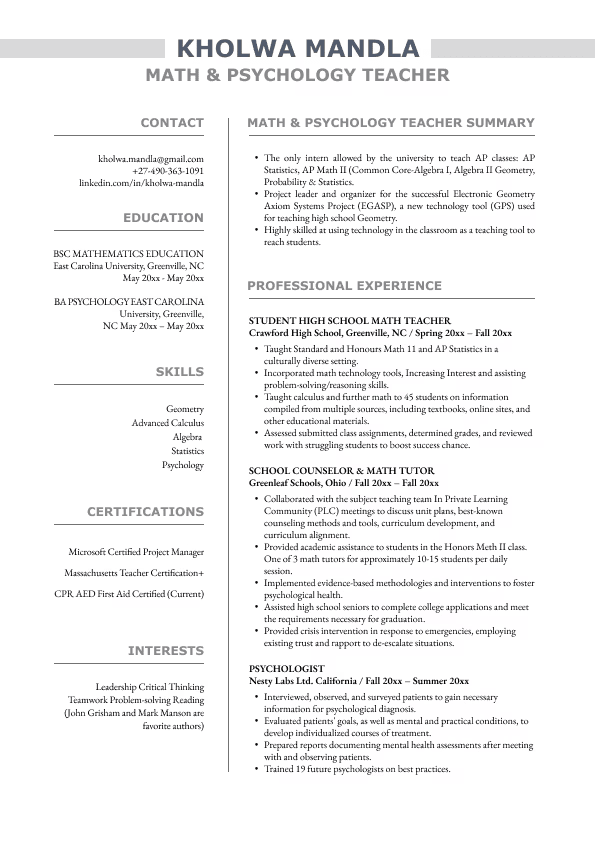
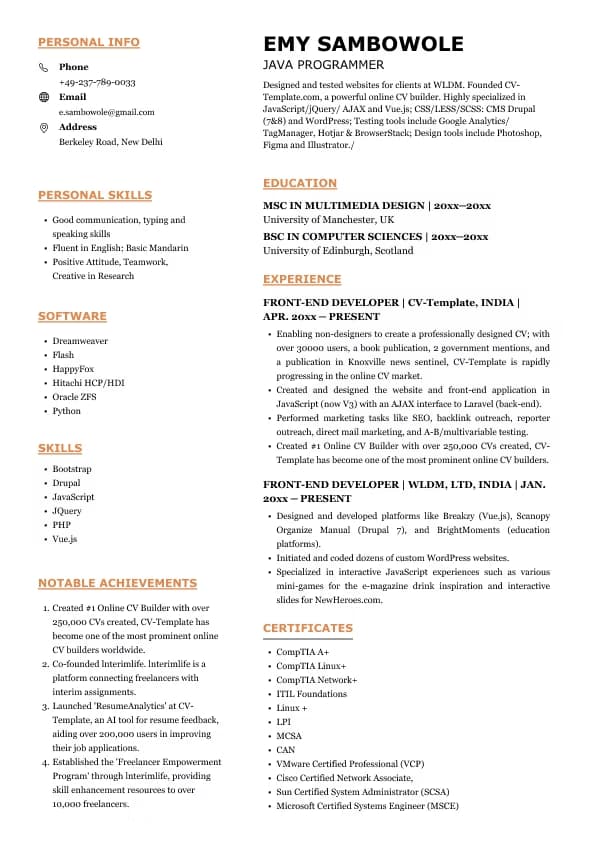
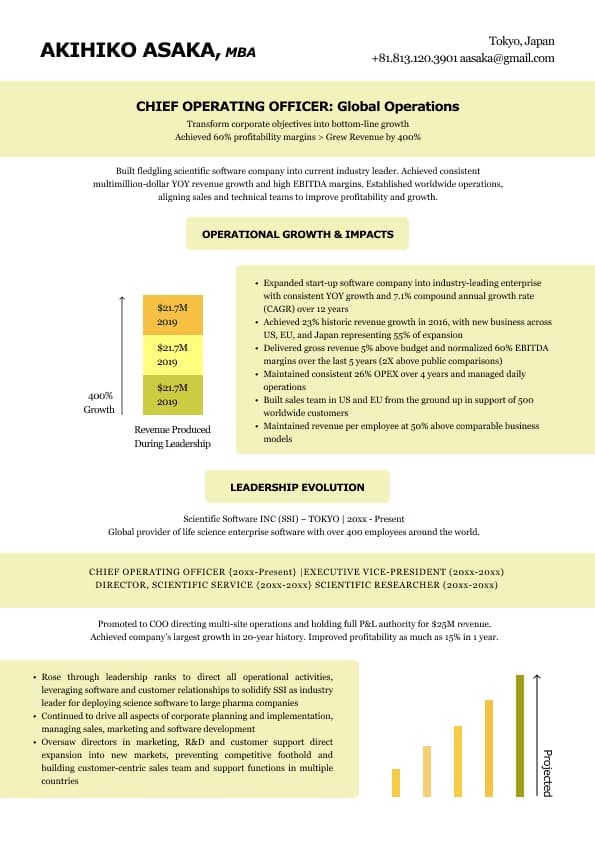
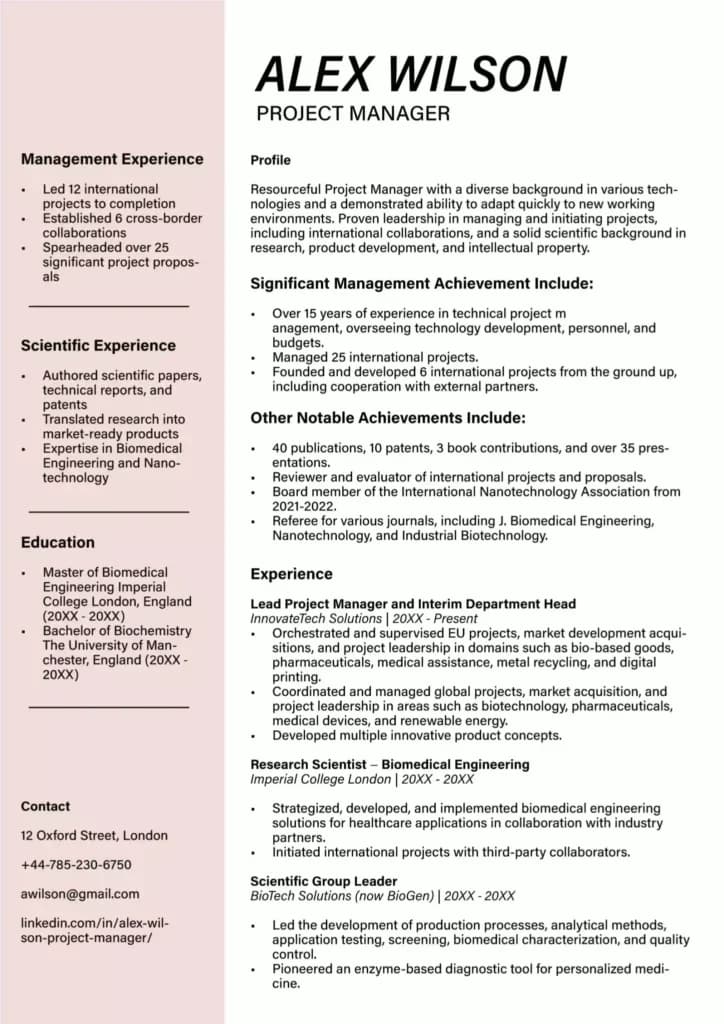
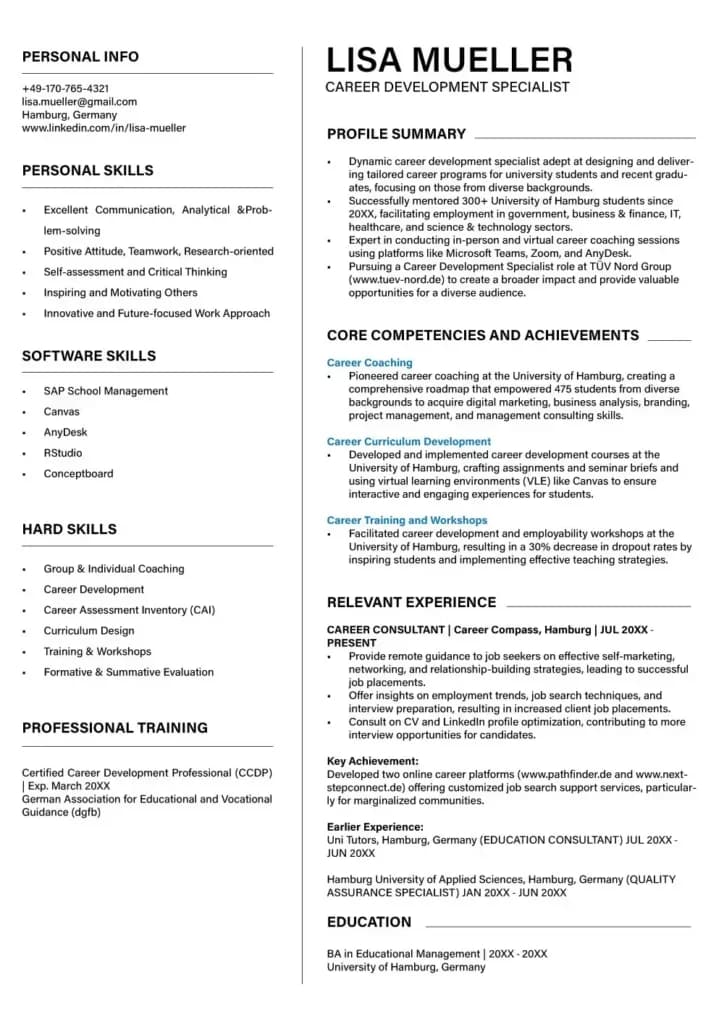
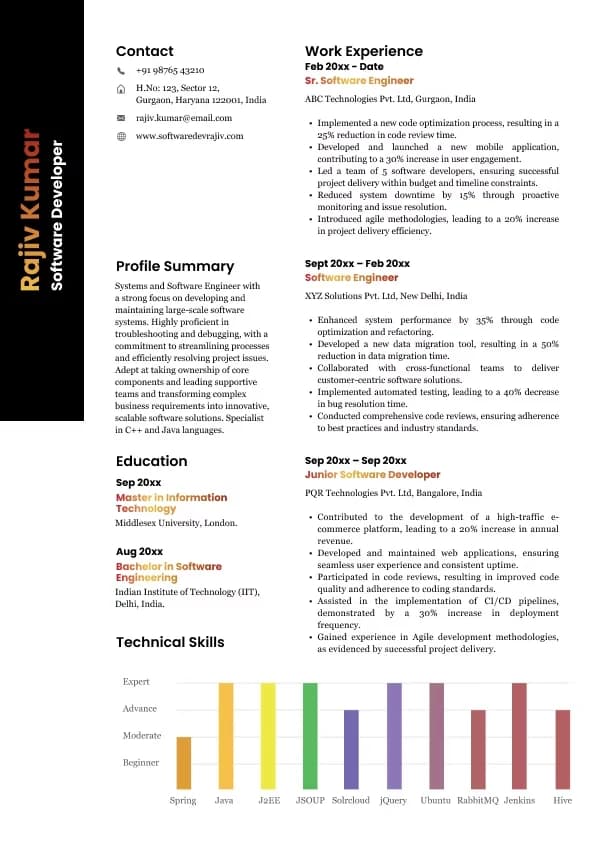
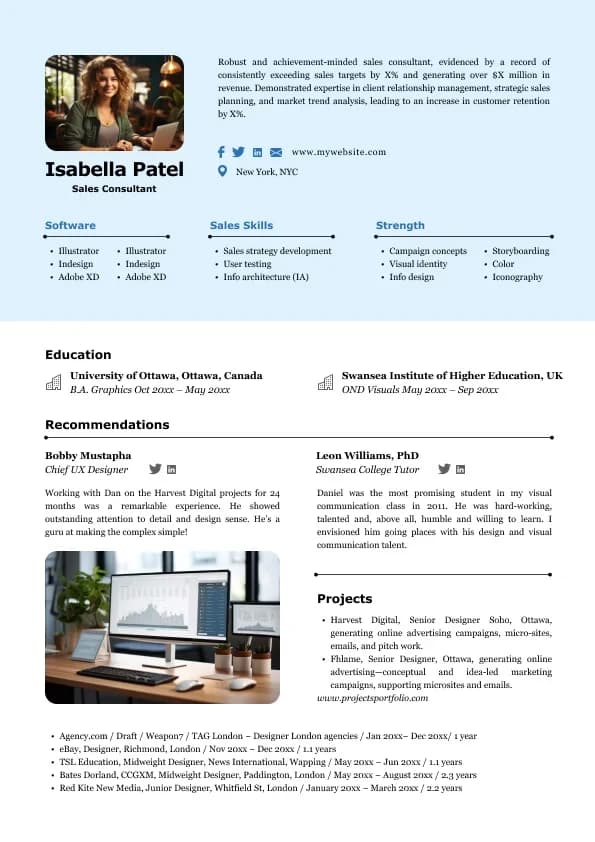
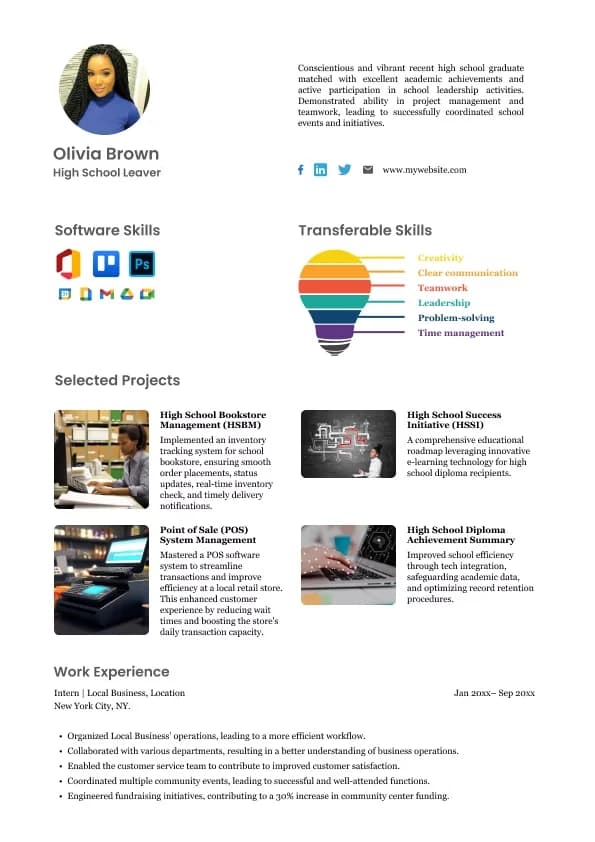
A curated sample of the full template gallery — see all the CV templates on CVJury.
Create a concise CV using our online CV builder. Feel confident in your job search with our online CV builder. Don't forget to check out our cover letter examples. Write your cover letter using our cover letter builder app with insider tips and techniques for the best cover letters.
Learn how to get job referrals and connect on LinkedIn by first adding value. You can choose from the most suitable CV templates.
Unleash Your Destiny: Crafting a CV of Limitless Potential
”
The only person you are destined to become is the person you decide to be.Ralph Waldo Emerson
With these powerful words in mind, we finalise this guide on how to write a good CV.
Throughout this journey, we have examined the various elements and strategies that can transform your CV, building a profile that genuinely impresses, turning it into a remarkable representation of your skills and potential.
Remember, success lies not only in inspiration but also in the unwavering belief in your abilities. In today's competitive job market, standing out is essential.
Whether you're a school leaver or a graduate, a skills-based CV can make all the difference. And even experienced workers can gain insight by following these tips.
Tailor your curriculum vitae to showcase your unique abilities, and remember to highlight the important tasks you've accomplished. Choose a CV layout that is concise and captivating, presenting your professional profile in a way that captures attention.
Joining professional memberships adds credibility to your CV and shows your commitment to growth. From primary school to now, you've developed valuable skills that can be applied in any role.
Remember, employers appreciate candidates who deliver results on time. So, craft a winning CV that highlights your skills and demonstrates your ability to execute effectively.
Your journey has prepared you for this moment, and with a skills-based approach, you'll unlock new opportunities and pave the way to success. Good luck!
Further Reading: How to Write a Good CV
- A Good CV tells your story skillfully (graduate CV)
- Use our free CV scanner
- 51 best LinkedIn summary templates
- LinkedIn profile builder
- Free online resume builder with any CV template
- Resume builder article to read
- Putting the work experience section in your CV rightly
About the author
Ita John
Founder, CVJuryDr Ita John founded CVJury in 2022. He previously worked as an IT recruiter in the London market for nearly seven years at Star Jobs Recruitment and founded the NECareersConnect careers platform. He brings experience in recruitment, practical project management, and business development. Earlier in his career, he taught business and economics at Oxford Brookes University and in Nigeria for over a decade. He lives in England with his wife and three sons. He earned a PhD in Entrepreneurship, International Business, and Economics from Oxford Brookes University. See how his background shapes the work he does for you. Read his story..
Connect
 LinkedIn
 Happenstance
