Resume & CV
How to Include Work Experience in Your Resume: The Ultimate Guide
Don't shoot yourself in the foot by excluding relevant past work experience details. Create a work experience section below your resume summary (if you're experienced) and below your education section (if you're a fresh graduate).
Written By Ita John
Founder, CVJury
Published 3 April 2024Updated 14 October 202617 min read

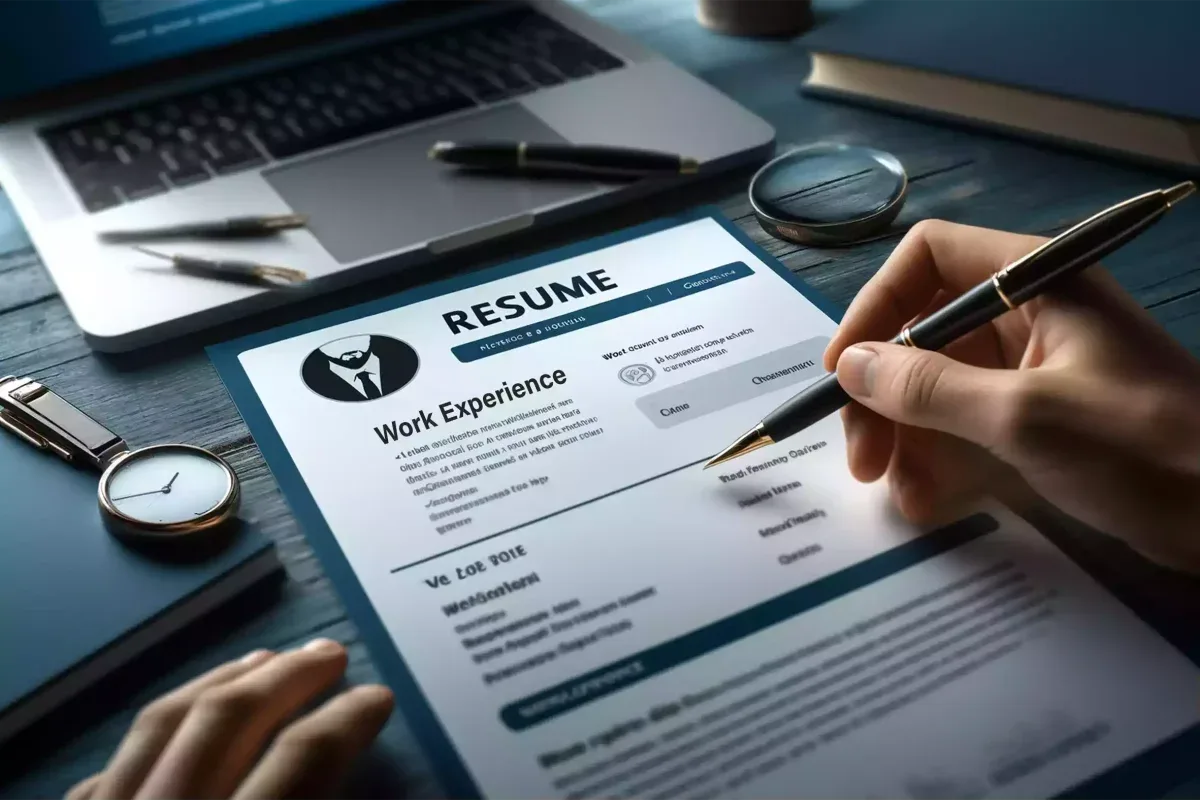
Don't shoot yourself in the foot by excluding relevant past work experience details. Create a work experience section below your resume summary (if you're experienced) and below your education section (if you're a fresh graduate). Use headings like WORK EXPERIENCE, PROFESSIONAL EXPERIENCE, WORK HISTORY, or EMPLOYMENT HISTORY in ALL-CAPS, bold, or a larger font size. Use reverse chronological order to list your work experience: begin with your most recent or current job, then list previous roles back to your first ever job. Include your job title, company name, and location, dates of employment, and achievements.
- Use bullet points to highlight your achievements and ensure they align with the employer's requirements.
- Emphasize your awards, wins, or achievements with action verbs, metrics, or numbers.
- As a fresh graduate, list your internships, university projects, or volunteer experience.
- Use resume builders to put together a compelling resume.
Discover James' Work Experience Mistake (And How to Avoid It)
"Where am I getting it wrong?" James had asked himself, distraught and heartbroken, crying his eyes out. "How did I mess this up again?"
James is a professional accountant with at least two years of work experience with a microfinance bank. He wants to change to a higher-paying job that will help him make ends meet.
He had sent his resume to different commercial banks, hoping for positive feedback. Sadly, it never came.
We both know how it feels to be at an emotional all-time low. James felt this way at that moment.
Worried about his present plight, he relayed his experience to his friend, who recommended me.
After interacting with him and checking his resume, I could tell where he had missed it because it stood out like a sore thumb.
There was no way any hiring manager would grant him an audience or invite him to an interview.
Where did it go downhill for him?
He had what it takes to get the job. However, his work experience section told a different tale; it didn't reflect his ability to deliver, qualifications, and wealth of experience.
Thankfully, after adding some significant details and making a few tweaks, we were able to rescue the situation and get him the good-paying job he deserved.
I'm about to reveal those key additions and adjustments to you to ensure that you don't learn the hard way, like James, or shoot yourself in the foot when writing your resume.
Whether you're a fresh graduate looking to break into the industry or an experienced professional looking for your big break, this post can help you get your desired results.
As you keep reading this article, you will discover:
- How work experience helps shape your career path
- Why decision-makers look for the work experience section on your resume
- What to include in your work experience section
- How to hit the right notes when writing your work experience section
- The best resume format to use: Reverse Chronological, Combination, or Functional
- And much more
Ready to discover all there's to know about the work experience on your resume and the steps to ensure you come across as a valuable addition to any company? Let's dive in.
What Is Work Experience?
Work experience refers to the specific time you spend on any paid or unpaid job to equip yourself with knowledge about a role, acquire relevant skills, and develop required work habits. It is the experience you gain from carrying out day-to-day operations on a job within a timeframe.
Work Experience: The Key to Career Advancement and Fulfilment
Employers prioritize skilled workers with hands-on experience, work ethic, and problem-solving capacity because they are a safer bet.
Therefore, if you fall into this category of job applicants, this is your ticket to the career of your dreams. These decision-makers need your services.
Oh, yes! You're an employer's delight. However, they won't know the stuff you are made of if you don't show them what distinguishes you from your competitors.
Want to win your prospective employer's heart? Include your work experience on your resume using the work experience section.
Whether you are planning to leave your present job for greener pastures or transition into a new industry, this is the best way to go.
What Is a Work Experience Section?
The work experience section, or job experience section, in your resume is where you give a comprehensive summary of your work experience or professional history.
It tells your career progression story via relevant information like achievements, acquired skills, employment dates, job responsibilities, previous jobs (internship roles, full-time jobs, part-time jobs, temporary jobs, or volunteer services), and past employers.
cvjury.com
CVJURY TOOL
Why Is the Work Experience Section on Your Resume Decisive?
Your potential employer will likely dash to your job experience section before reading any other part of your resume.
This is because it gives them insight into your career path and what you bring.
With this information at their fingertips, they can decide if you possess the required experience, skills, and strengths to succeed in the job you have your eyes set on.
So, put on a good show to get to the interview stage. Here's your opportunity to sell yourself, tell your story, and highlight your achievements. Seize the moment.
What to Include in Your Work Experience Section
Including the correct details begins with maximizing your job experience section to position you as the perfect fit for an open position. Include the following:
- Official job title (e.g., Senior UI designer)
- Company or employer's name and location (e.g., Imperial Valley Tech Solutions, New Orleans, Louisiana)
- Employment dates (e.g., 2021 – present)
- Achievements (e.g., Developed a user-friendly application that exceeded the needs of our clients, improving their customer satisfaction by 20%)
Now, that is the tip of the iceberg. Ready to get right into the meat of the matter? Here we go!
How to Add Work Experience to Your Resume
Finally, it's time to write your work experience section. Your fingers are placed on your keyboard as you ponder how to list work experience. It is make or break. You know it. But don't worry. Follow these proven steps below to the letter and boost your chances of sweeping recruiters off their feet.
1. Lay Down the Foundation
Laying down the foundation is vital to writing a professional experience section. It simplifies the process and ensures that no stone is left unturned.
Begin by gathering all the details you'll need from your present job to your previous jobs.
If need be, this is the best time to research and ascertain every piece of information before beginning the writing process.
Don't attempt writing a work experience section until every detail you intend to include is accurate. You can't afford to give misleading information.
2. Choose the Right Location
This is where it all begins. It sets the stage for what is to come. However, it is worth noting that the location solely depends on your experience level. Here's how it works:
- If you have a sufficient work history, place your work experience section below your resume summary.
- On the other hand, if you're a fresh graduate without much experience, put your work experience section under the education section.
3. Create a Work Experience Section
Carving out a clear-cut work experience section that catches the eyes of most recruiters is key. They won't notice what you can offer if you can't see their eyes. So, here's what you should do:
- First, give this section a befitting title that decision-makers can identify with, e.g., Experience, Employment History, Work Experience, Work History, or Professional Experience.
- Then, make sure this title is bolder or louder than the other words that will come under this section. You can achieve this by using all caps, a larger font size, or the bold option.
4. Use the Reverse Chronological Order for Job Descriptions
Studies show that hiring managers take about 11 seconds to check a resume. This means that you have to start off on the right foot.
Thankfully, this resume format works a treat in helping you create a captivating first impression. Here, you get to mention your relevant work experience in reverse order.
Hence, you'll begin with your present or most recent job, down to your first-ever job.
This way, hiring managers see your most impressive job before diving into your career progression journey and learning how you climbed the ladder to your present job.
5. Start with Your Job Title
Always begin with your job titles when introducing your job descriptions at the companies you worked for.
Dos
- Web Designer
Don'ts
- Web Design Wizard
Since the reverse chronological order demands that you begin with your most recent job, your first job title is equal to your latest or current job title.
6. Introduce the Company Name and Location
Next is the company name and location. This information comes in handy for recruiters when they need to confirm whether you are familiar with their industry.
In other cases, if you have experience with a blue-chip company, it gives the impression that you're well-trained and worth inviting to an interview.
Furthermore, your potential employers may need to fact-check with your previous employers. This is what it should look like:
- Dynamic Microfinance Bank, New Orleans, Louisiana
7. State Your Different Employment Dates from Past Jobs
Dates of employment highlight the specific phase in your career when you worked for a company or organization.
Although it's popularly known as Dates of employment or employment dates in the resume world, you are not required to provide the specific date.
Rest easy, you don't have to rack your brain to remember the exact dates. Instead, you can mention the month and year based on your work history.
Dos
- June 20XX – August 20XX
Don'ts
- June 20 of 20XX – August 25 of 20XX
8. Describe Your Achievements in Terms of Responsibilities
Describing how you achieved impressive feats while executing your daily tasks is best.
In today's competitive job market, where only a few job seekers get invited to an interview, listing your job responsibilities won't cut it.
Here's why: hiring managers are already familiar with these responsibilities.
Remember, the job posting was for applicants who meet specific requirements. They know what they're looking for, so don't bore them to tears.
Instead, see this as an opportunity to sell yourself as the groundbreaker or problem solver their company needs to achieve their goals or move to the next level.
cvjury.com
RESUME SCANNER
Dos
- Say, 'Implemented an effective inbound and account-based sales strategy that improved monthly sales by 11.7%.'
- Say, 'Delivered 790 quality office supplies to 11 IT firms in New York in 20XX, retaining an ongoing maintenance contract.'
Don'ts
- Do not say, 'In charge of sales,' as this does not communicate precisely what you did, achieved, or by what means.
- Do not say, 'Delivery of office supplies.' Use an active word or verb that conveys your action more potently than a noun.
The message is similar. However, the latter drives the message home, while the former sounds ordinary. And trust me, you don't want to come across as "ordinary" to these decision-makers. So, turn their heads with your accomplishments.
9. Add a "Key Achievements" Section
Want to capture decision-makers' attention and eventually blow their minds? Go one step further by including a "key achievements" section. As the name suggests, this section is for achievements you take pride in. This is your trump card. Use it to your advantage.
How to Get the Best Out of Your Work Experience Section
Do you know your resume can still get lost in the shuffle even after including the basic requirements in your work experience section? You don't want this to happen. Here are a few tried and tested resume work experience writing tips you can apply to catch the hiring manager's eye and give yourself an edge over other applicants:
Tailor Your Work Experience Section to Suit the Desired Job
Don't just glance at a job ad, assuming that every company demands similar requirements, and send in a copy of your supposedly "one size fits all" resume. I tried this, and it didn't end well.
Instead, pay attention to the job ad and pick up the specific requirements and other relevant information required to create a work experience section that suits the job you are applying for.
In a nutshell, be innovative. Turn details in job ads into helpful content for your work experience section.
Include Relevant Keywords from the Job Ad
The Applicant Tracking System (ATS) has become the go-to option for hiring managers because it makes it easy to narrow and screen out candidates, saving them time and effort.
ATS categorizes submitted resumes and scans them for specific keywords to pinpoint candidates well-suited to the company's job ad.
You'll be overlooked if you don't have these vital keywords. Ensure you are not found wanting in this regard.
Use Bullet Points for an Important Job Description
Be concise. Quickly shift the focus of hiring managers to your important job description by using bullet points. Leave out any information that does not add value or strengthen your work experience section.
Use Action Verbs
Action words or verbs give voice to your excellent work or big wins. They are game changers.
Hence, if you're working on your present company's project and it's already yielding positive results, use the "present tense action verbs."
On the other hand, if you've wrapped up the project or have notable achievements from your previous jobs, use the "past tense action verb." Here are a few examples of past-tense action verbs:
Past Tense
- Assisted
- Conducted
- Developed
- Directed
- Enhanced
- Implemented
- Led
- Managed
- Organized
- Performed
- Supervised
- Trained
Here are a few examples of present-tense action verbs:
Present Tense
- Assists
- Conducts
- Develops
- Directs
- Enhances
- Implements
- Leads
- Manages
- Organizes
- Performs
- Supervises
- Trains
Add Significant Metrics or Numbers to Make Achievements Captivating
Using relevant metrics or numbers to show your accomplishments is undoubtedly one of the most effective ways to scream, "Look no further. I'm the man for the job." So, here are a few metrics or numbers you can include when stating your achievements to convince decision-makers about your ability to deliver:
- The timeframe it took before you got a promotion (e.g., Promoted after six months due to immediate impact, impressive leadership qualities, and work ethic).
- Work Quantity (e.g., Managed over 250 interns and part-time workers).
- Project Size (e.g., Developed a user-friendly application that improved customer retention by 70% and customer acquisition by 40%).
- Delivery in record time (e.g., led a team of 20 up-and-coming designers to deliver a client's design in 2 days, beating the 5-day deadline).
- Increased percentage (e.g., trained and provided feedback to my team members, leading to a 35% increase in productivity).
- Reduction in percentages (e.g., Conducted a customer survey and applied the suggestions, resulting in an 80% reduction in customer churn).
- Profits, Revenue, or Sales generated (e.g., Implemented the XYZ marketing strategy that brought in over $70,000 in sales).
Edit the Errors Out
Take time to review what you have written. This will help you catch and edit any spelling, grammatical errors, or misinformation.
How to List Job Gaps in Your Resume
If you have gone six months or more without a job, you might consider hiding it, but don't attempt it.
Indeed, any job gap in your resume can throw a spanner in your good work.
However, you can rescue the situation by giving a convincing explanation to back up its presence.
Since many employers immediately assume the worst possible scenario when they see a job gap, you must clear the air.
Now, how do you achieve this? It's simple. And you don't have to tell the whole story from the beginning. Instead, all you have to do is use, at most, two lines to shed light on what happened. Here's an example:
- From January 20XX to August 20XX, due to critical health conditions, I had to avoid the demands of a working environment to find my feet and return even more substantial.
And that's a wrap. No more, no less.
How to Write Your Work Experience Section as a Recent Graduate
Graduation day remains one of my best memories. I can't forget the excitement that filled the air and the smiles on the faces of my loved ones.
Unsurprisingly, it felt way better after I landed my first job and celebrated with family and friends. But it wasn't smooth sailing. I took some hits when applying for jobs before I tasted success.
Like any graduating student, I had targets. I wanted to excel in my industry and be on par with my experienced counterpart.
But here lies the problem: my lack of experience limited my job-winning potential. I was rejected by all the companies I applied to.
Nonetheless, I continued to work hard until I hit the jackpot.
Want to know what I did differently? Here's how you can come up with an impressive work experience section regardless of your lack of experience:
Ensure You Aim for Entry-Level Jobs
I aimed for companies or organizations that welcome recent graduates with little or no experience with open arms via entry-level jobs.
These companies specifically create these job opportunities for recent graduates.
Here, no hiring manager expects years of experience you don't have.
Use these entry-level jobs as stepping stones to landing your dream job. Below are some job-finding tips to find jobs faster:
- Use freelancing platforms like Fiverr or Upwork to find jobs
- Don't be afraid to approach industry professionals in your vicinity to enquire about job openings
- Leverage your network (family, friends, former college students/colleagues, or university project partners)
- Use social media platforms like LinkedIn to connect with professionals and decision-makers
Add Your University Projects
Besides helping you cross the finish line where you get rewarded with a degree, your university projects can also help you nail a job.
Did something laudable during the project, or create a product that solves a pressing problem? Feel free to mention it.
Include Your Summer Jobs
Have you ever gotten a summer job to waste time or make urgent cash? Now is a good time to refer back to it, even though it doesn't relate to the job you're gunning for.
It is proof that you have been in a working environment before. So, you possess soft skills that you can apply on the job. This gives you an edge over fresh graduates with eyes on the same position.
Mention Your Exciting Personal Projects
If you have created new things that meet the needs of a target audience, don't hold back. Include these exciting or promising projects in your resume.
Highlight Your Extracurricular Activities
You can also highlight extracurricular activities like your hobbies, interests, or volunteer experience, where you learned relevant skills that can help you adapt to the job seamlessly.
4 Ways Our Resume Builder Can Help You Write Your Work Experience Section
Crafting an irresistible job experience section is much easier than ever, thanks to the emergence of resume builders. These days, you can come up with a top-quality resume in minutes.
I would have given an arm and a leg to access a resume builder when I wanted to change jobs for the first time. Slightly exaggerated, yeah. But for real, I wouldn't have struggled like I did.
Fortunately, you won't have to go through a similar struggle. You know why? Because I walked so you could run.
Based on my decades of experience and expertise in making job-winning moves, I created a game-changing resume builder that helps you write a compelling work experience section. Sounds promising, right?
Nonetheless, you're probably wondering how it helps you. I'll tell you. It provides you with:
- Relevant keywords that ensure that the ATS doesn't screen out your resume.
- Ideal resume formatting, saving you the stress of finding the best-suited format for your work experience section.
- Professionally designed templates for your desired job, helping you get the best out of your work experience section. You're spoilt for choice. All you have to do is make your pick.
- Resume examples that suit your experience level. Whether you are an experienced professional (with at least three years post-graduation work experience), a manager, or a fresh graduate, this resume builder has got you covered.
The best part is that you get FREE access to all these benefits, with no hidden charges.
How to Use Our Resume Builder to Write Your Work Experience Section
Yes, I know. Creating an irresistible resume in record time excites you. You're eager to get the ball rolling, so you can have a head start on your competitors. I get it. But pump the brakes for 2 minutes and allow me to demonstrate how to navigate this builder in 5 easy-to-follow steps:
You're good to go. Click here to get started now.
Practical Examples of a Work Experience Section
At this point, you know how to ensure that your resume's work experience section gets decision-makers screaming, "Wow! What a valuable asset. We can't let this candidate slip through our hands."
But now, it's time for me to show you a practical job-winning resume example. Pay attention to the "Experience or Work Experience" section. Ready? Lights, camera, action!
cvjury.com
TEMPLATE
cvjury.com
TEMPLATE
cvjury.com
TEMPLATE
cvjury.com
TEMPLATE
cvjury.com
TEMPLATE
Q: Should I Include the Organization Where I Worked for 2-3 Months in My Job Experience Section?
A: Yes, if it's your only work experience. In this case, highlight the soft skills you gained and what you accomplished.
Also, ensure you share details on why your stay was short in your attached cover letter.
On the other hand, if you have job experiences where you stayed for a long time, avoid mentioning your 2-3 months of experience.
This can be a red flag to employers, making them wonder why you didn't stay long on the job.
It also gives the impression that you're a job hopper, which can harm your chances of getting to the interview stage.
Q: Can I Put My Volunteer Work Under Work Experience?
A: Yes, you can if it will strengthen your resume. You can also create or dedicate a specific section highlighting the history of your volunteer work related to development.
Q: Can I Mention My Internships?
A: Of course, you can, if you're a fresh graduate. It shows you've worked with a company or organization, sitting at the feet of professionals in the field. Don't mention it if you have up to 5 years of job experience.
There you have it. Nonetheless, if you've more questions, feel free to contact us. We'll be glad to help.
cvjury.com
CVJURY TOOL
Unlock the Doors of Interviews With Your Work Experience
As you now know, including your work experience in your resume “strategically” is one of the surefire ways to win the heart of your prospective employer.
But unfortunately, most job seekers miss this trick and lose out on their desired jobs. They have no idea how to leverage their work experience, even if they have what it takes.
Now, this is where you can strike while it's hot and edge out your competition. Use your previous work experience from your past jobs or previous positions to book yourself a seat at the next interview.
Want to stand out from other candidates and leave your potential employer in awe?
Apply the actionable tips in this guide when writing your resume's work experience.
You've got what it takes to sweep employers off their feet. It's time to show it.
I'm rooting for you.
Meanwhile, to master writing a resume like a guru, click here.
Cheers to your success!
Continue Reading
How to write a resume like an expert. The best resume fonts.
About the author
Ita John
Founder, CVJuryDr Ita John founded CVJury in 2022. He previously worked as an IT recruiter in the London market for nearly seven years at Star Jobs Recruitment and founded the NECareersConnect careers platform. He brings experience in recruitment, practical project management, and business development. Earlier in his career, he taught business and economics at Oxford Brookes University and in Nigeria for over a decade. He lives in England with his wife and three sons. He earned a PhD in Entrepreneurship, International Business, and Economics from Oxford Brookes University. See how his background shapes the work he does for you. Read his story..
Connect
 LinkedIn
 Happenstance
