Cover Letter
How to Write a Cover Letter That Proves Fit
Match the role, prove your fit with evidence, and close professionally.
Use the job description to choose the right proof, connect it to one specific role, and write a letter that adds to your resume or CV instead of repeating it.
Written By Ita John
Founder, CVJury
Published 30 March 2024Updated 12 October 202612 min readA global guide for active job seekers

Your resume or CV shows where you have worked and what you have done. A good cover letter earns its space by doing what your resume or CV cannot do as easily: explain why this specific position makes sense for you, prove the match with relevant evidence, and make any obvious career move easier to understand.
If you are learning how to write a cover letter that says something useful, start with the job description for the role. Mark the job title and two relevant skills or requirements you can prove. Use that proof in the opening, show your genuine interest in the role or company, then finish with a clear close. Do not leave your reason for wanting this job unstated.
The National Careers Service describes a cover letter as usually 3 to 5 paragraphs. Harvard's Mignone Center for Career Success and WorkBC advise keeping it to one page. Treat those as useful defaults, then follow the employer's instructions when the application system asks for something different.
Who this is for: an active job seeker responding to a specific opening. This is a global guide. Whether you need to submit one, and how you handle the mailing address, greeting, sign-off, and file format, can vary by market and employer, so the application instructions come first.
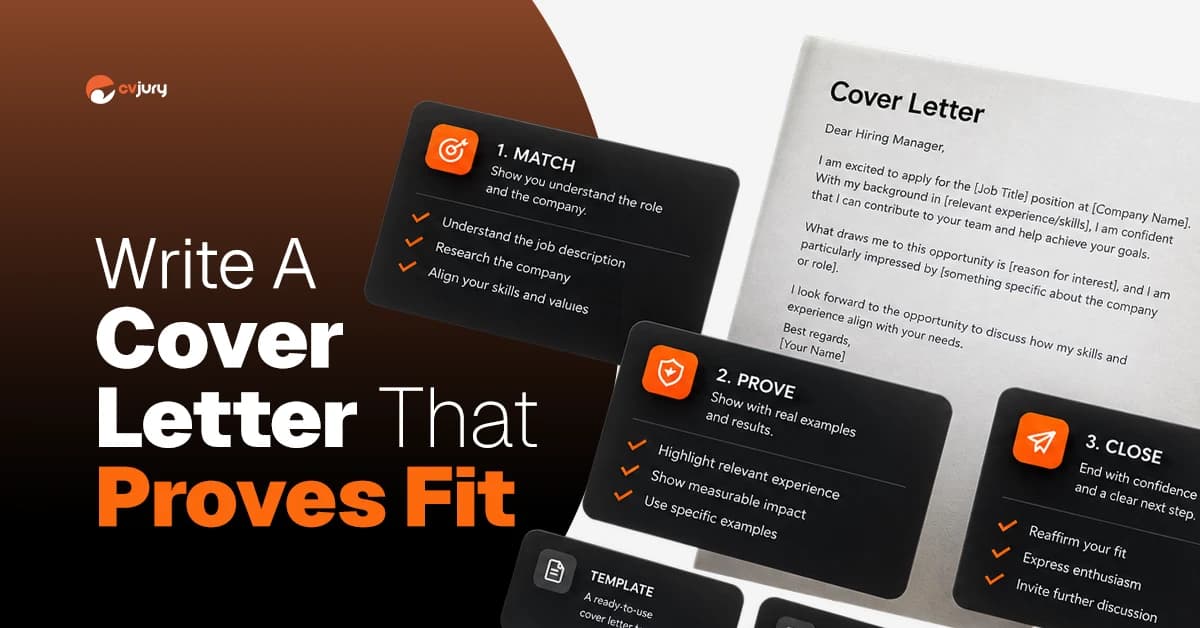
One Writing Route:
Match > Prove > Close
Step 1
Match
Match the role and your reason for choosing it.
Step 2
Prove
Prove the fit with evidence from work, education, projects, volunteering, or other relevant experience.
Step 3
Close
Close professionally after you have made the case.
Before You Write a Cover Letter, Mark What the Job Needs
Read the job description once for the role as a whole. On the second pass, highlight the duties, qualifications, and key skills you can support with evidence from work, education, projects, volunteering, placements, or other experience.
You do not need every keyword. The specific job description is your filter. Keep wording from the posting only when it truthfully matches what you have done. Then check the employer's website for the work, product, service, or mission that gives you a real reason to apply. The National Careers Service and WorkBC both recommend tailoring the letter to the opening rather than sending the same generic letter each time.
Practical tip: Research has one purpose here: help you answer why this role, at this organization? Do not copy a mission statement or praise the company in vague terms. Find one fact that connects with the work you want to do.
Set Up the Cover Letter Before the Opening Paragraph
For a formal cover letter sent as an attachment, place your name and contact details at the top. Add your mailing address, the date, and recipient details when the format calls for them. Online forms and email applications may already collect some of this additional information.
- Recipient: use the hiring manager's name when you can verify it. If the posting mentions a Human Resources contact or another specific person, use that person.
- Fallback greeting: when no reliable name is available, use "Dear Hiring Manager" or a team-based greeting.
- File format: if the employer asks for PDF, DOCX, email text, or another format, use it. If the posting states no format, use a file type the application accepts and open the final file before sending.
- Presentation: keep the same font throughout the letter. You do not need the same heading as your resume.
Keep the writing polite and direct. If the role asks for written communication skills, the letter itself is also a writing sample.
Write Cover Letters With Match → Prove → Close
Use the three parts in order: establish the match in the opening, prove it in the body, and close once the case is made.
Match: Write an Opening Paragraph for This Position
The first paragraph should name the position and establish the match quickly. Your first sentence does not need a dramatic hook. It needs to say something useful.
Before and after: make the opening prove the match
The stronger version replaces generic traits with evidence that connects directly to the opening.
WEAK
I am writing to apply for the Project Coordinator position. I am hardworking, organized, and a team player.
STRONGER
I am applying for the Project Coordinator position. In my current position, I coordinate handovers across sales, design, and operations, which matches the cross-team planning in this opening.
What changed: the rewritten opening names the job title, removes unsupported traits, and gives the hiring manager evidence for the first impression. A successful cover letter starts making the case for this job in the opening rather than spending the opening on generic enthusiasm.
Prove: Use the Body Paragraphs to Show Your Relevant Skills
The second paragraph, or middle paragraph in a shorter letter, should do more than list skills. Choose one or two relevant skills or requirements and show your skills in action.
- What was the task, problem, or responsibility?
- What did you do?
- Who or what did your work affect?
- What changed, finished, improved, or became easier?
Highlight one or two accomplishments that match the job description. Use metrics or specific examples when they truthfully show scale or what changed. Numbers are not required. A completed project, a resolved customer issue, training a colleague, improved handover, or a completed analysis can also demonstrate your qualifications.
| Job Requirement | Your Proof | Cover-Letter Sentence |
|---|---|---|
| Coordinate work across teams | [Project] + [teams] + [result] | In my position at [employer], I coordinated [project] across [teams], helping [result]. |
| Explain technical information | [Audience] + [topic] + [what happened] | I explained [topic] to [audience], which helped them [truthful result]. |
WorkBC recommends concrete proof, and Harvard advises focusing on a small number of job-matched proof rather than repeating the resume. Use the letter to give selected evidence more useful detail.
Then connect the relevant evidence back to the employer. Do not stop at I did X. Show why X matters for this role.
Answer the Question Your Resume or CV Leaves Open
This is where a cover letter can explain an obvious career move: if your career history creates a real question, answer it before you close. If that career move is your concern, stick to the gap the application actually shows. Do not invent fears for the hiring manager.
If you are changing careers: connect your transferable skills to the work you want now.
Possible wording: My background in [previous field] gave me [transferable skill]. I am moving into [target field] because [specific responsibility] is the work I want to focus on now.
If the role is less senior than your recent position: state the reason if the choice is not obvious.
Possible wording: This role is not a fallback for me. I am applying because [specific responsibilities] are the work I want to focus on now, and they match the work I want to do in this stage of my career.
If you have little formal experience: use education, a project, placement, volunteering, or part-time work as proof. Focus on the proof you do have rather than apologizing for what you do not.
If you have an employment gap: keep the explanation brief and factual when the gap needs an explanation. The National Careers Service advises focusing on skills or experience gained during the gap rather than writing a long defense of it.
Keep the explanation relevant: do not volunteer age, retirement plans, salary expectations, or worries about being difficult to manage simply because you fear someone may think about them. If the application does not raise the issue, adding it can distract from your evidence. Answer the visible question, then move on.
Close: Finish With a Clear Closing Paragraph
The closing paragraph should thank the reader, confirm your interest, and invite further discussion. The National Careers Service recommends thanking the employer and saying you look forward to hearing from them. Harvard gives comparable guidance on a professional close.
Possible close: Thank you for your consideration. I would welcome the chance to discuss how my experience in [area] fits this position, and I look forward to hearing from you.
Use a professional sign-off such as Sincerely, Regards, or the local equivalent that fits your greeting and market.
Annotated Cover Letter: What Each Section Is Doing
CVJury's internal 16 Cover Letter Styles file contains 16 ways to shape a letter around the applicant's situation. The annotated sample below is useful because every main section has a job: identify the role, give evidence that matches the work, explain why this employer makes sense, and close once the case is made. Use the call-outs as a test for your own draft. If a paragraph cannot help answer one of those questions, it may not deserve the space. If your letter still reads like a copy of your resume or CV, rebuild it section by section with CVJury's Cover Letter Builder.
CVJURY SAMPLE

The margin questions in the original sample are not a second formula. Read them through the current route: Who are you? supports Match; How do you best fit the role? is Prove; and Why this organization? supplies the employer reason inside Match/Prove. The sign-off is Close.
1
Call-out 1, Match
The opening says who the applicant is as a professional and points to the type of work they do. It does not spend the opening on adjectives.
2
Call-out 2, Prove
The middle block tells one career story and gives outcomes. The point is not the exact number in the sample. The point is that the claim has evidence behind it.
3
Call-out 3, Why here
The following section shows why this company's work interests the applicant. This sits inside Prove because it connects the applicant's direction with the employer's needs instead of becoming a separate writing process.
4
Call-out 4, Close
The letter stops after it has made the case. The sign-off does not introduce another achievement or another reason for applying.
5
Optional career-context check
This sample does not need one. An extra sentence can earn its place when a career change, non-traditional background, or another visible move needs explanation. Add it only when the application creates the question.
Cover Letter Template You Can Adapt
Use this cover letter template as a writing guide. Replace every bracketed part. Remove any statement that does not help this application.
[Your name]
[Your address, if the format calls for it]
[Phone] | [Email]

[Date, if the format calls for it]
[Recipient name]
[Recipient job title]
[Company name]
[Company address, if the format calls for it]

Dear [verified recipient name],

Re: [JOB TITLE]

After reading [annual report, company update, or posting], I am applying for the [Senior Buying Manager] role because [specific part of the role or company plan] matches my experience in [buying or commercial area].

In my current role, I am responsible for [the Beers, Ales, and Cider categories]. I have [overachieved budgeted sales by 12% (£2.5 million)] while [negotiating an additional £12 million in business plan support].

I have also [delivered total group savings of £2 million within the Vegetable, Soda, and Horticulture category] and [created and developed a multi-national produce buying team in the UK].

Your [specific growth plan, business priority, or challenge] interests me because [truthful reason tied to the work]. My experience in [area] would help me contribute to [specific responsibility or target named in the posting].

Thank you for considering my application. I would welcome the opportunity to discuss how my experience fits the [job title] role.

Regards,
[Your name]
[Attachment note, if needed]
If the same wording still works after changing only the company name, customize it again. Once you know how to write a cover letter around one opening, reuse the structure for other applications, not the job-specific argument. For each new job opportunity, rebuild the evidence and the reason for applying.
Six CVJury Cover Letter Examples and What to Notice
About these examples: The annotated sample above teaches the method; the six client examples below show how it changes by role and situation. CVJury wrote these cover letters for clients. The clients permitted publication after their names and exact addresses were changed. They are first-hand writing samples, not evidence of interview or hiring outcomes.
Example 1: Open With a Problem You Solved
CVJURY SAMPLE

The opening moves from a work problem into proof from past projects. Use this approach when the problem you solved is more persuasive than a list of personality traits.
Example 2: Combine Interest With Account Evidence
CVJURY SAMPLE

The opening states the account-management position and interest in the company. The middle of the letter then shifts to client and campaign evidence. Notice the order: the claim appears, then the proof.
Example 3: Connect Technical Work With Business Results
CVJURY SAMPLE

This letter links financial analysis with decisions and outcomes. The useful lesson is the connection between technical knowledge and the business problem the work supports.
Example 4: Annotated Client Letter
CVJURY SAMPLE

1
Call-out 1, role and recipient
The letter names the project-management opening and uses a named recipient. The reader knows what application they are looking at before the evidence starts.
2
Call-out 2, Match
The opening places project-management experience near the top. It does not make the reader wait for the applicant's professional identity.
3
Call-out 3, Prove
The achievement list turns broad project-management claims into separate pieces of evidence. The list also makes multiple results easier to scan than one dense block.
4
Call-out 4, employer link
The letter connects past digital-integration work with the employer's stated expansion plans. Use the research to show why the past evidence matters to this employer.
5
Call-out 5, Close
The final lines invite a discussion and then stop. It does not add a new claim after the case has already been made.
Example 5: Let the Voice Fit the Work
CVJURY SAMPLE

The voice is more conversational, but the letter still includes campaign evidence. Tone changes with the application; proof does not disappear.
Example 6: A Good Cover Letter Can Be Short When the Evidence Is Clear
CVJURY SAMPLE

The nursing letter names the position, gives care-related evidence, includes a qualification, and closes without unrelated detail. For other layouts, see CVJury's letter templates.
Check Your Cover Letter Before You Send It
- Confirm the correct role.
- Highlight evidence from this posting in the opening.
- Back every major claim with proof.
- Explain any surprising career move without sounding defensive.
- Remove resume lines that add no explanation.
- Check the company, organization, person, dates, and figures for accuracy.
- Remove filler, repeated points, and spelling mistakes.
- Follow the application instructions.
Read it aloud once. If it does not sound like the way you would talk to a person, rewrite it. For more tips on the final check, use CVJury's guide to cover letter mistakes.
Cover Letter FAQs
Should I send a cover letter when it is optional?
Read the job posting first. WorkBC advises applicants to check the posting because not every job requires a letter. When it is optional, send one when it adds job-matched evidence, motivation, or useful context that the rest of the application does not show as well.
Can I use AI to help with cover letter writing?
Use AI for brainstorming or editing, then verify every fact and rewrite generic output around your own experience and the exact posting. Harvard's Mignone Center for Career Success advises using generative AI as an editing aid rather than the primary author.
Key Takeaways
- Start with the job description and the position you want.
- Highlight one or two pieces of proof instead of repeating your resume.
- If your career story creates an obvious question, answer it in one short statement.
- Address a specific person only when you can verify the name.
- Keep it concise and follow the employer's submission instructions.
BEST NEXT STEP
Build Your Cover Letter With CVJury
If you want to see how to write a cover letter around your own job posting, use CVJury's Cover Letter Builder to choose a template and rebuild your letter section by section with your own contact details, company information, introduction, skills, experience, and closing. Use the builder for structure, then add your own job-matched proof and check every name, claim, and figure.
Keep the Proof Yours
Use the builder for structure. Keep names, claims, figures, and job-matched evidence accurate.
More Resources and Sources Checked
National Careers Service, “How to write a cover letter”
Length and structure, recipient guidance, job-title placement, employer research, tailoring, closing, and proofreading.
Checked August 19, 2026 View source
WorkBC, “Resume and Cover Letter”
Checking the job posting, one-page guidance, concrete evidence, job-description wording, and avoiding resume repetition.
Checked August 19, 2026 View source
Harvard FAS Mignone Center for Career Success, “Create Impactful Resumes and Cover Letters”
One-page guidance, job-matched proof, closing, and AI editing guidance.
Checked August 19, 2026 View source
National Careers Service, “Explain a gap in employment”
Brief employment-gap guidance.
Checked August 19, 2026 View source
CVJury, “Cover Letter Builder”
Used only for the visible builder steps described in the CTA.
Checked August 19, 2026 View source
CVJury, “16 Cover Letter Styles (internal PDF)”
The annotated sample and the career-stage variations.
Reviewed August 18, 2026
CVJury, “Make Your Cover Letter Objection-Proof (owner-supplied editorial note)”
The applicant-side idea of answering an obvious career question.
August 18, 2026
About the author
Ita John
Founder, CVJuryDr Ita John is the founder of CVJury. He previously worked as an IT recruiter in the London market for nearly seven years at Star Jobs Recruitment and founded the NECareersConnect careers platform. He brings experience in recruitment, practical project management, and business development. Earlier in his career, he taught business and economics at Oxford Brookes University and in Nigeria for over a decade. He lives in England with his wife and three sons. He earned a PhD in Entrepreneurship, International Business, and Economics from Oxford Brookes University. See how his background shapes the work he does for you. Read his story.
Connect
 LinkedIn
 Happenstance
