Resume & CV
CV Achievements: How to Find Yours and Write Them Well
Look again at the work you call ordinary. Some of your strongest CV achievements are already there.
Ask what changed, what you contributed and what evidence you can defend. Use numbers when you have them. When you do not, use scope, difficulty, consistency, recognition or a useful outcome.
Written By Ita John
Founder, CVJury
Published 5 August 2024Updated 12 October 202613 min readPrimarily for a UK CV audience

How to Find and Write Your CV Achievements
Most CV achievements are not awards. They are results, improvements, problems solved, extra responsibility handled or recognition earned through everyday work. Start with a duty, ask what changed, then use the strongest evidence you can support.
Find
Look at everyday work and ask what changed.
Prove
Use numbers when you have them. Otherwise use scope, difficulty, consistency, recognition or a useful outcome.
Write
Combine the action, the work or problem, and the strongest evidence you can defend.
You know your duties. The harder part is spotting the evidence inside them. A problem you solved, a process you improved, extra responsibility you handled or a result you helped deliver can all become stronger CV evidence when you show what changed.
If your CV lists duties more easily than evidence, use this guide to find key achievements, choose the ones that fit the job, write them well, and place them in the right part of your CV structure.
What Counts as a CV Achievement?
A CV achievement shows contribution, not just what you were assigned to do. It can come from paid work, education, volunteering, research, special projects or other relevant experience.
Work achievements include increased sales, cost savings, process improvements, problems solved, targets met, projects delivered, customer feedback, industry recognition or extra responsibility handled well. Academic achievements include strong grades, academic awards, research, publications and substantial projects. A degree is usually a qualification, not an achievement.
A routine duty becomes achievement material when you can show a result, scale, difficulty, improvement or recognition tied to your work. Doing a task as expected is valid experience, but not automatically an achievement.
In resume-led markets, you will also see accomplishment or professional accomplishments used for the same idea. Applying in the US or Canada? See CVJury's Resume Accomplishments guide.
Duty vs Achievement: Look for the Missing Evidence
Weak Duty
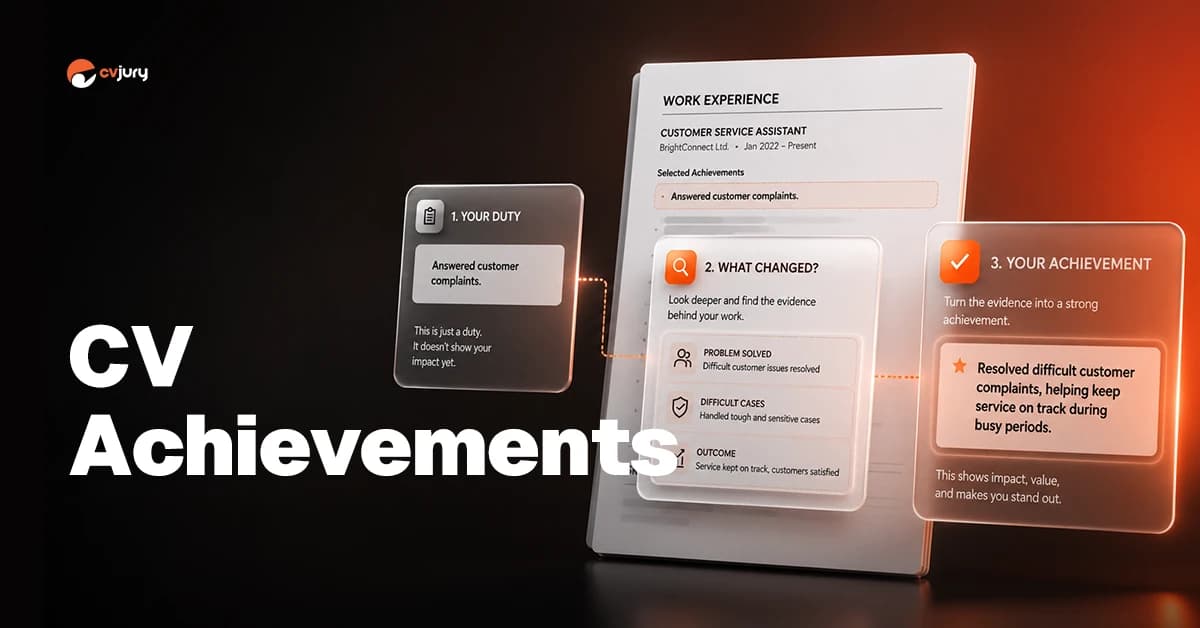
Answered customer complaints.
Stronger CV Achievement
Resolved difficult customer complaints, helping keep service on track during busy periods.
The stronger line adds difficulty and an outcome without inventing a customer satisfaction score. The customer service CV further down shows the same move on a real CV.
Your skills section can name key skills such as problem-solving or customer-service skills. Achievement lines show those skills in use, turning job duties into evidence of contribution.
How Do You Find Key Achievements When Your Work Feels Ordinary?
I rarely see someone with no achievements. More often, useful work gets dismissed because it did not come with a prize, promotion or percentage. Start with your normal responsibilities rather than trying to remember only exceptional moments.
Use the "What Changed?" Test
Take one responsibility and ask: what became better, faster, safer, easier or more reliable because I did this? Look for a measurable result, a problem fixed, extra scope, a deadline met, a difficult situation handled or recognition received.
| Basic Responsibility | Question to Ask | Achievement Direction |
|---|---|---|
| Managed appointments | Did delays, cancellations or confusion fall? | Scheduling reliability or service improvement |
| Answered complaints | What difficult cases did you resolve? | Customer resolution or issue handling |
| Prepared reports | Who used them and what did they support? | Decision-making, accuracy or reporting quality |
| Trained colleagues | What became easier or more consistent afterwards? | Team development or knowledge transfer |
| Maintained records | What errors, delays or compliance problems did you prevent? | Accuracy, control or risk reduction |
Do not force a result you cannot support. If nothing changed, keep it as a responsibility and look elsewhere for stronger evidence.
Use an Evidence Ladder Instead of Chasing Percentages
Start with your strongest evidence. Quantifiable achievements help, but numbers are only one kind of proof. Evidence can also show scale, comparison, scope, frequency, outcomes without figures, or recognition such as employee awards or industry awards.
Exact result
A verified increase, reduction, saving, target or other recorded measure.
Approximate scale
A truthful range or volume estimate when the exact number was not recorded.
Comparison
Before and after, or against a stated deadline.
Scope
Locations, teams, customers, systems or complex projects supported, when known.
Frequency
Repeated delivery, such as meeting every monthly deadline, when accurate.
Outcome without a figure
Cleared a backlog, prevented an error, restored a process or resolved a recurring problem.
Recognition
An award, commendation, strong appraisal or extra responsibility you can verify.
How to Write CV Achievements
Use one pattern: action + work or problem + evidence or result. The evidence does not have to be a number.
Start With the Action, Then Show What the Work Produced
Start each achievement bullet with the verb that accurately names what you did: analysed, resolved, trained, implemented, reduced, delivered, coordinated or improved. For more options, see CVJury's strong action verbs guide.
Then add the work, problem or project and your strongest evidence. Replace vague claims such as "made a big impact" with the change itself.
Use Measurable Results When You Have Reliable Numbers
Useful numbers include money saved, sales won, time cut, volumes handled or errors reduced, when the figure is accurate and you can trace it to your own work. For sales work, reliable evidence can include sales figures, increased sales, quarterly sales targets or conversion rates. Use revenue growth only when you can trace the figure to your own contribution.
Use a percentage or £ figure only when it is yours to claim. For a cross-functional team result or wider company growth, describe your contribution without claiming an outcome you cannot trace to your work.
What to Write When You Do Not Have an Exact Figure
Use the evidence you have. Completed technical outputs, problems solved, deadlines met, risks prevented and recognised responsibility can all show useful contribution. Label estimates as estimates instead of presenting them as precise figures. For confidential results, state the direction and scope without disclosing private information.
Which CV Achievements Should You Include?
Choose CV achievements for the job you want, not the ones that merely sound impressive. Your best career achievements connect your previous roles with the work you want to do now.
How to Tailor Achievements to a Job Description
Read the job description and mark the key skills, responsibilities and results it asks for. Compare them with achievements from your work history, education, projects and volunteer work. Keep the closest evidence.
Do not copy the job description into your CV. Use it to decide which achievements deserve space, then choose evidence that shows the requested skills through work you actually did.
Repeat this job description check for each serious job application. Change the order, remove weaker examples and highlight achievements that fit the role better. This is how you tailor achievements without rewriting truthful evidence.
Keep achievements that are relevant, believable and backed by evidence. Personal achievements belong when they prove something useful for the job; leave personal life milestones out when they do not.
Where Should You Add Achievements on Your CV?
Your work experience section is usually the best home for achievements from a specific job. Put them under the role where they happened so the evidence sits beside the relevant experience.
| CV Area | Use It When |
|---|---|
| Personal profile, CV summary or personal statement | You have one highly relevant result that helps establish your fit quickly. |
| Work experience | The achievement came from a specific role. This is the usual location for work achievements. |
| Education | The evidence comes from strong grades, academic awards, research, projects or other academic achievements, especially when you have limited paid experience. |
| Projects or volunteering | The work happened outside paid employment and is relevant to the job application. |
| Dedicated achievements section or awards section | You have relevant recognition or evidence that does not sit naturally under one role or qualification. |
Use a separate achievements section when strong evidence comes from different parts of your background and will not fit under one role, qualification or project. Check that your CV template gives it a clear home. Do not repeat bullets already listed under your jobs.
A skills section can name a capability, but keep stronger evidence beside the experience, project or education that produced it. That helps potential employers trace the proof.
How Many Achievements Should You Include?
There is no proven number for every CV. Start with about three to five strong achievements under a recent, relevant role and fewer under older jobs. Never pad a role just to reach a quota; keep only the achievements that best explain your contribution.
CV Achievement Examples
Three short examples, then two full CVs we rewrote in 2026.
Analysed Delinquent Accounts to Identify Recurring Payment Problems, Helping Reduce Bad Debt
Why it works: It names the analysis, the problem behind it and the direction the result moved. No percentage is invented to prop it up.
Ran Email Campaigns Across Two Channels and Increased Engagement, Which the Team Linked to New Revenue the Following Quarter
Why it works: The channels are named, the change is real, and the wording stops short of claiming a company revenue result as one person's doing.
Identified Design Flaws in an Ongoing Project That Could Have Caused Equipment Failure
Why it works: The evidence is a risk prevented. That counts, and it is more honest than guessing at a financial saving.
Before and After: Two UK CVs We Rewrote in 2026
Both CVs below were written for people applying in the UK. Both people agreed to have their CVs shown with names, contact details and employers removed. Nothing in the new versions was invented; the evidence was already there, in the wrong words or the wrong place.
Customer service CV: proof without a single number
Before
Before

Before

After
Before

This CV came from someone with ten years of order-desk, billing and customer service work behind them. The first version ran to two pages and packed more than twenty bullets under one role. Almost every line started with "Creating", "Providing" or "Assisting", and none of them said what changed.
What we changed:
Turned duty-heavy bullets into evidence by showing what happened after the work was done.
Brought out the outcomes that were already there: fewer order delays, clearer support steps, better handling of difficult cases, stronger cover for a team of 10 to 15.
Cut more than twenty bullets down to six, so the useful ones could be seen.
Removed parents' names, hobbies and a signed declaration. UK employers do not expect them.
Look at the new version again and count the percentages. There are none. Every bullet earns its place through scope, difficulty, a problem solved or something that became easier for the team.
How we found the evidence. When someone tells me they have no achievements, I ask about the work itself. What changed? What became easier, better, safer or more reliable? What problem did you solve? Those questions almost always turn up evidence the person never thought to put on a CV. That is how these bullets were written.
Before
Functioned as Subject Matter Expert (SME) for Billing process/Sales support/CSR/Order desk.
After
Acted as the go-to person for billing, sales support, customer service, and order-desk queries, helping the team handle difficult cases more consistently.
Why the change works: The first line gives a job label. The second says what the label meant day to day and what the team got from it. No figure was available, so none was invented. The evidence is the reliance placed on this person.
Data Analyst CV: The Right Evidence in the Wrong Place
Before
Before

Before

After
Before

Before

An economics and business graduate applying for UK data analyst roles. The proof of their data skills, social surveys, interviews, infographics and engagement results, sat at the bottom of page two under the heading "Volunteering". Above it were nine soft-skill labels and a title lifted straight from a job advert.
What we changed:
- Moved the research, data and project work high on page one, under a section name that says what it proves.
- Cut the soft-skills list. Words like "passionate" and "adaptability" prove nothing standing alone.
- Kept the strong academic results visible, because paid experience was short.
- Named the team size and changed "resulting in" to "contributing to" where the result belonged to a group.
Both versions run to two pages, which is normal for a UK CV. Nothing was invented and nothing was cut for space. What changed was the order: the evidence a data employer needs now sits on page one, under a heading that says what it proves.
Before
Collaborated with a team of 2 to promote an online educational platform, resulting in a 30% increase in user engagement.
After
Helped promote an online learning platform as part of a two-person team, contributing to a 30% rise in user engagement.
Why the change works: Same figure, honest share. "Resulting in" claims the whole result; "contributing to" claims a part of it. The team size moves to the front, so nobody has to guess how much of the 30% belongs to one person.
Figures shown in the data analyst CV were supplied by the applicant and were not checked with employers or programme operators. The customer service CV contains no figures or customer satisfaction score.
CV Achievements for Graduates, Students and Career Changers
Education, internships, volunteering, research, projects and community work can all contain CV achievements when they show a relevant contribution.
Academic Achievements When You Have Limited Experience
If you are a recent graduate, look beyond the qualification title. Strong grades, academic awards, research, publications, substantial projects, leadership, internships and demanding coursework can all supply evidence.
The data analyst CV above shows how project and volunteer work can carry the evidence when paid experience is short. That is especially useful for a recent graduate. Do not claim improved accuracy or time saved when your records do not support those results.
Career-Change Achievements: Take the Proof, Not the Old Job Title
Your key career achievements do not lose their value because they came from another industry. When changing careers, start with the new job description, mark the key skills, then scan previous jobs, education, projects and volunteer work for evidence that transfers.
An achievement from another industry can still matter when it proves transferable skills such as analysis, communication, leadership, programme delivery, customer service or problem-solving. New skills can help you change fields, but older achievements can prove abilities the new role needs. The job title shows where you used the skill; the achievement shows what you did.
The CV Book and Modernize Your Resume land in the same place: lead with the skills and knowledge the new role needs, not the places you picked them up (Innes, 2016, p.127; Enelow and Kursmark, 2023). This keeps your career story focused on evidence the new role can use.
The data analyst CV shows this: research and survey work done unpaid still proved the skills a data role asks for.
Common CV Achievement Mistakes
The Duty List
Every bullet says what you were responsible for, but none shows a result, problem fixed, scope, difficulty or recognition.
The Empty Achievement
The bullet uses vague claims such as "improved efficiency" without evidence.
The Made-Up Metric
A percentage or money figure is added because achievement advice says numbers are better.
CV Achievement Self-Check
- Does this achievement support the role I am applying for?
- What changed, improved, was completed, prevented or made easier through my work?
- What evidence can I support: result, scale, comparison, scope, frequency, outcome or recognition?
- Have I separated my contribution from a wider team or company result?
- Would I be comfortable explaining the wording and any figure if asked?
- Does this line match something useful in the job description without copying it?
- Is this the best place for the achievement on this CV?
Keep an accomplishment bank so your strongest evidence is ready when you need to tailor a CV.
| Problem | What You Did | Result | Evidence Source | Skills Proved | Jobs This Suits |
|---|---|---|---|---|---|
| Customer complaints during busy periods | Resolved difficult cases | Helped keep service on track | Service records or manager feedback | Customer service; issue resolution | Customer service; support roles |
Add these achievements to your CV in the CVJury CV Builder.
CV Achievements FAQs
Can personal achievements go on a CV?
Yes, when personal achievements provide relevant evidence for the job. Focus on what they prove and leave out personal life details that do not help potential employers assess your fit.
Can volunteer achievements count?
Yes. Volunteer achievements can show initiative, community commitment, leadership, research, service or project skills. Put them under volunteering or projects when that gives the evidence a natural home.
Should every achievement contain a number?
No. Accurate numbers help with scale, but a problem resolved, risk prevented, backlog cleared, difficult work completed, recognition received or extra scope can also prove an achievement.
Can I use the STAR method to find achievements?
Yes. Use STAR to remember the situation, task, action and result, then shorten the CV bullet so its action, work and strongest evidence are easy to see.
Key Takeaways
- CV achievements show contribution or evidence, not only assigned duties.
- Start with ordinary work and ask what changed because of your contribution.
- Use the strongest truthful evidence available. Exact numbers are only one option.
- Career changers can reuse relevant proof from another industry when the skill or result travels to the new role.
- Do not invent a figure, exaggerate causation or copy an example that you cannot defend.
Review your three most recent roles, projects or qualifications now. Where a line only states a duty, ask what changed, what proof you have and whether it helps the job you want.
CVJURY CV BUILDER
Put Your Achievements Into a Finished CV
Once you have written your strongest achievements, use CVJury's CV Builder to add them to a complete CV.
Keep the Evidence Honest
Use the strongest result you can support. Do not add a number simply because a bullet looks stronger with one.
Sources and Methods
Sources
James Innes (2016). The CV Book. 3rd edition. Pearson Education Limited, Harlow, United Kingdom.
Wendy S. Enelow and Louise M. Kursmark (2023). Modernize Your Resume. Get Noticed … Get Hired. Emerald Career Publishing, USA.
Method
The two CVs shown here come from CVJury reviews completed in 2026 for people applying to UK roles. Both approved anonymised use. Names, contact details and employer names are removed from the images.
They were chosen because they show two different problems. One had no usable figures at all. The other had strong evidence sitting in the wrong place.
About the author
Ita John
Founder, CVJuryDr Ita John is the founder of CVJury. He previously worked as an IT recruiter in the London market for nearly seven years at Star Jobs Recruitment and founded the NECareersConnect careers platform. He brings experience in recruitment, practical project management, and business development. Earlier in his career, he taught business and economics at Oxford Brookes University and in Nigeria for over a decade. He lives in England with his wife and three sons. He earned a PhD in Entrepreneurship, International Business, and Economics from Oxford Brookes University. See how his background shapes the work he does for you. Read his story.
Connect
 LinkedIn
 Happenstance
